Sage Estimating vs STACK vs PlanSwift: $50M GC Teardown
Mid-market GCs evaluating estimating software end up at three platforms. Each is built for a different shop. Here is the honest decision matrix.

TL;DR. Mid-market GCs evaluating estimating software end up at three platforms: Sage Estimating, STACK, and PlanSwift. Sage Estimating wins if you are already on Sage 300 CRE and have a dedicated estimator who can run a 4 to 8 month implementation. STACK wins if you want cloud-native takeoff and estimating in one platform with a 2 to 6 week ramp. PlanSwift is the cheapest, fastest 2D takeoff tool in the evaluation, but it is not a full estimating system, and most $50M GCs who buy it still produce final estimates and proposals in Excel and Word.
Your two estimators spend the first three days of every bid measuring PDF plans with a 2008-era takeoff tool, and the last two days rebuilding the same Excel cost model they rebuilt last bid. A competitor just won a $4.2M tenant improvement job with a quote that landed in 36 hours. Your CFO is asking why two estimators looking at the same drawing produce two different numbers. Every vendor sales engineer will tell you they are the right answer. They are not. The real answer depends on what accounting system you run, how many estimators bid the same job at once, and whether you have a senior estimator who can spend 90 days configuring a tool you only use 200 times a year.
The real evaluation set at $50M
At $50M, the GC estimating evaluation narrows to four tools: Sage Estimating, STACK, PlanSwift, and Procore Estimating (if you are already on Procore). Procore Estimating is bundled into Procore's platform tiers, so it comes down to whether your firm has committed to Procore as the system of record. The other three are sold standalone and represent the real evaluation set. Every other tool on the Construction Executive 2026 estimating roundup is either too small (Buildxact for sub-$5M remodelers), too large (Trimble WinEst for enterprise civil), or too specialized (HCSS HeavyBid for heavy-civil earthwork).
Each of the three is built for a fundamentally different shop. Pick wrong and you will spend two years and $80K migrating.
Sage Estimating: built for Sage 300 CRE shops
Sage Estimating is the heavyweight. It supports trade-specific databases (electrical, mechanical, civil) and integrates tightly with Sage 300 CRE (formerly Timberline) and Sage 100 Contractor accounting. If your GL runs in Sage and estimators want assembly-based estimating with RSMeans cost data flowing in automatically, this is the tool. A bid becomes a budget in Sage Job Cost without re-keying.
Pricing. $10,000 to $20,000+ per user per year, plus $10,000 to $30,000 in implementation. Sage Estimating requires a Sage-certified consultant to configure the database, train the estimators, and wire it into your existing GL. Most $50M GCs land at $35,000 to $60,000 in year one for a two-estimator deployment.
Implementation time. 4 to 8 months for a clean rollout. You buy it and start using it the following bid season. If your sales rep is promising a faster ramp, they are quoting the install, not the time-to-productive.
Takeoff. The surprise: Sage Estimating does not have first-class 2D takeoff the way PlanSwift or STACK do. Most Sage shops still use Bluebeam Revu (about $440 to $660 per user per year) or a Sage-integrated takeoff add-on for PDF measurement, then feed quantities into the estimating assemblies. Budget for the second tool.
Where it wins: a $50M GC running Sage 300 CRE, with 2+ dedicated estimators and enough volume to justify the depth. Where it loses: any GC not already standardized on Sage. The value proposition collapses outside the Sage ecosystem.
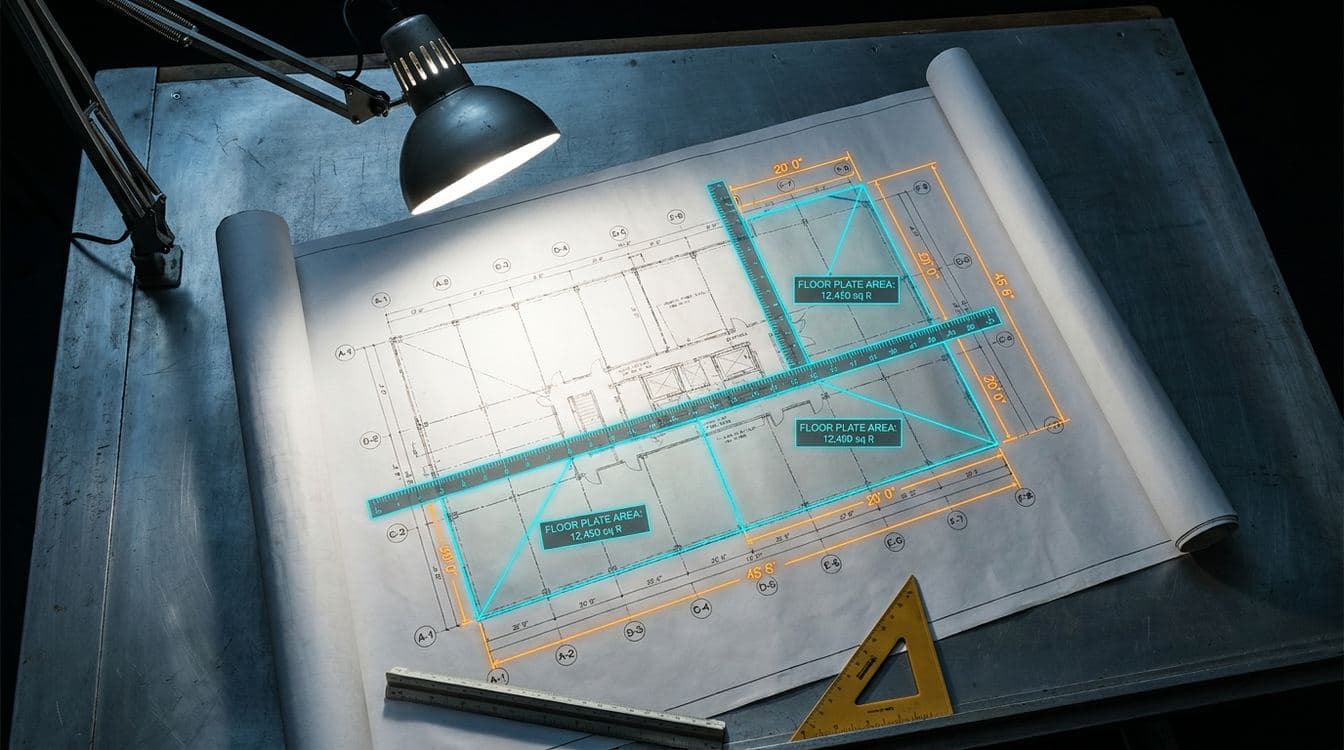
Real takeoff work happens at the intersection of the printed drawing and the digital measurement layer. Three platforms approach this differently.
STACK: the cloud-native default
STACK is what mid-market GCs adopt when they want cloud-native takeoff and estimating in one platform without an enterprise implementation. Pricing is transparent, onboarding is 2 to 6 weeks, and the takeoff capability is genuinely good. Estimators measure PDF plans on screen, calibrate to scale, and pull quantities directly into a unified estimate without exporting to Excel.
Pricing. Pro tier around $2,499 per user per year, Premium around $2,999. Most $50M GCs spend $10,000 to $20,000 per year for a 4 to 6 seat deployment, including a shared cost library tier. Implementation is included. No certified consultant required.
Cost database. STACK's built-in cost library is functional but less deep than RSMeans. Most STACK shops build their own pricing library over the first 90 days using historical job data. This requires a senior estimator who can codify the firm's pricing logic.
ERP integration. STACK exports to Excel and integrates with Procore, QuickBooks, and a handful of other systems through standard connectors. It does not have the tight native integration with Sage 300 CRE that Sage Estimating has. If your job costing lives in Sage and you want estimates to flow into Job Cost without re-keying, this is a real friction point.
Collaboration. STACK was built for distributed estimating teams. Multiple estimators can work the same bid simultaneously, mark up the same takeoff in real time, and roll up costs without merging Excel files. For a $50M GC with two-to-five estimators bidding in parallel, this is the strongest feature in the evaluation.
Where it wins: mid-market GCs prioritizing speed, collaboration, and cloud access who do not need deep Sage integration. Where it loses: shops with mature Sage 300 CRE workflows that depend on assembly-based estimating and native bid-to-budget handoff.
PlanSwift: the takeoff specialist (and where firms get caught)
PlanSwift is the cheapest of the three and the most misunderstood. It is a 2D takeoff tool first and an estimating tool second. Pricing runs $1,500 to $2,800 per user per year, onboarding is 2 to 4 weeks, and the customizable formula engine wins over estimators who came up on Excel.
PlanSwift is not a full estimating system. This is the trap. PlanSwift will measure your PDFs faster than any other tool here. It will not generate proposals, manage subcontractor bids, or flow into your accounting system. Firms that buy PlanSwift expecting an estimating platform typically still build the final estimate in Excel and produce proposals in Word. We have seen $50M GCs spend $8,000 on PlanSwift seats and discover six months later they still need an estimating system on top of it.
Trimble ownership. PlanSwift is owned by Trimble, which gives you reasonable confidence the product will keep being updated. It also means PlanSwift will eventually face pressure to integrate with the broader Trimble construction stack (WinEst, Sketchup, Tekla) rather than evolve as an independent best-of-breed tool.
Formula engine. PlanSwift's customizable formulas are genuinely good. An estimator can define "every 8x8 column equals 320 lbs of rebar plus $480 in formwork plus 2.4 hours of labor at $42 per hour," save it as an assembly, and reuse it across bids. Faster than Sage's assembly editor, more flexible than STACK's templates.
Reporting. Weak. PlanSwift's bid output is functional but not polished. If your bid packages need detailed line-item breakouts for owner review, the formatting work happens outside PlanSwift.
Where it wins: a $50M GC where takeoff speed is the bottleneck and your Excel-based estimating workflow works. Where it loses: any firm trying to standardize estimating across multiple estimators. PlanSwift's lack of structured estimating means each estimator's bid still looks different at the end.
What each platform actually does at $50M
| Capability | Sage Estimating | STACK | PlanSwift |
|---|---|---|---|
| PDF takeoff | Limited (pair with Bluebeam) | Strong | Strongest |
| Assembly-based estimating | Strong | Moderate | Weak |
| Cost database | RSMeans + Sage library | Built-in, shallower | None (you build it) |
| Proposal generation | Strong | Moderate | None |
| Subcontractor bid management | Yes | Limited | No |
| Sage 300 CRE integration | Native | Export only | None |
| Procore integration | Partial | Strong | None |
| Multi-estimator collaboration | Limited | Strong | Limited |
| Implementation time | 4 to 8 months | 2 to 6 weeks | 2 to 4 weeks |
| Annual cost (2 to 5 seats, year 1) | $35K to $60K | $10K to $20K | $3K to $10K |
The pattern: Sage Estimating is the most capable and the heaviest commitment. STACK is the best mid-market default. PlanSwift is the best takeoff tool, but only a takeoff tool.
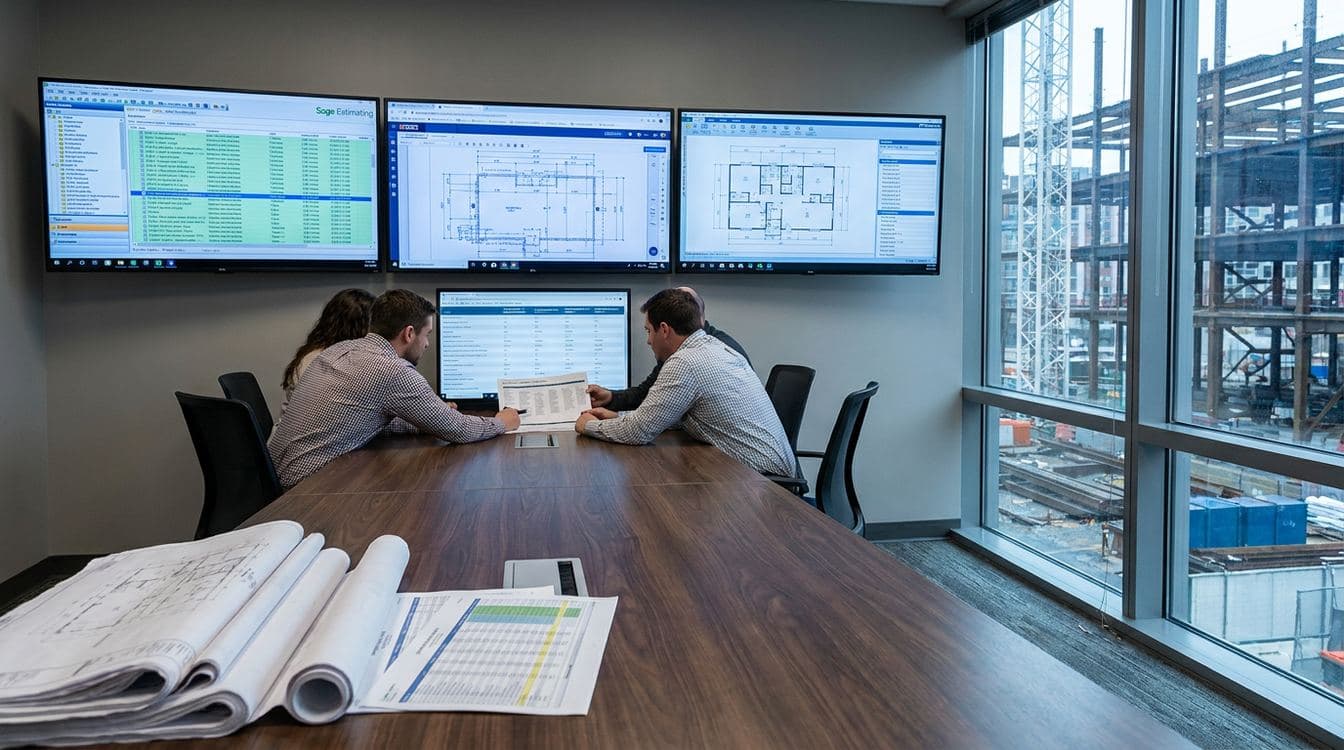
The real evaluation happens in the bid room, not the vendor demo. Most $50M GCs make this decision wrong on the first pass.
The decision matrix for $50M GCs
The framework comes down to five questions:
- Are you already on Sage 300 CRE for accounting? Yes: Sage Estimating is the only choice with native integration. No: skip it.
- Do you have a senior estimator who can spend 90+ days configuring assemblies and pricing libraries? Yes: Sage Estimating's depth pays off. No: STACK's faster ramp and built-in templates produce better bids in less time.
- Are your estimators bidding the same job in parallel? Yes: STACK's real-time collaboration is the biggest single win. PlanSwift and Sage Estimating both struggle here.
- Is the bottleneck takeoff speed or estimating standardization? Takeoff: PlanSwift plus Bluebeam Revu is under $5,000 per estimator per year. Standardization: PlanSwift alone will not get you there.
- What does your bid handoff look like? If estimates flow into Sage Job Cost as budgets, Sage Estimating is the only platform that does this natively. If you re-key into job cost anyway (most $50M GCs do, even on Sage accounting), the integration value drops considerably.
For most $50M GCs we work with, the honest answer is STACK for the cloud-native estimating workflow, paired with Bluebeam Revu for plan markup and a custom pricing library built over the first 90 days. Sage Estimating only makes sense if you are already deep in the Sage 300 CRE ecosystem. PlanSwift makes sense only as a pure takeoff tool paired with an Excel workflow you have no plans to retire.
This decision sits adjacent to the accounting platform decision. If you are evaluating both, sequence the accounting choice first. Estimating is downstream.
Where AI fits (and where it does not yet)
Every vendor in this evaluation is selling AI in 2026. Most of it is feature marketing. Where AI actually moves the needle right now:
Automated quantity extraction. Tools like Togal.ai, Joist AI, Bidi Contracting, and STACK's "AI Takeoff" beta extract counts of windows, doors, fixtures, and standard items from drawings in seconds. For a $50M GC bidding 50 to 150 jobs a year, this saves 8 to 12 hours per bid on quantity-heavy scopes. Accuracy is not yet good enough to skip human review.
Subcontractor bid leveling. None of the three estimating platforms handle this well. Bidi Contracting, Joinpaq, and other AI-native tools are building bid-leveling layers that work alongside Sage, STACK, or PlanSwift. If your bottleneck is comparing 8 sub bids on the same scope, this is the AI use case worth evaluating.
What AI is not doing yet. Generating finished bid packages, replacing senior-estimator judgment, or pricing first-of-its-kind scopes. AI shows up as a workflow accelerator on specific steps, not a replacement for the estimating system. See Why Your First AI Agent Should Not Be a Chatbot for the broader pattern.
FAQ
Is Sage Estimating still worth it in 2026? Yes if you are on Sage 300 CRE and have a dedicated estimator. The integration depth and assembly-based estimating are best-in-class for Sage shops. No if you are not in the Sage ecosystem; the cost and complexity do not justify the depth.
Is PlanSwift a full estimating tool? No. PlanSwift is a 2D takeoff specialist with light estimating attached. Most $50M GCs that buy PlanSwift still produce final estimates and proposals in Excel and Word.
How long does STACK actually take to implement? Two to six weeks, depending on whether you are importing a cost library or building one from scratch. Most $50M GCs are productive within 30 days of signing.
Should I bundle estimating into Procore if I already use Procore? Maybe. Procore Estimating is part of Procore's tiered platform pricing, not standalone. For a $50M GC already paying $25,000 to $50,000 per year for Procore, adding the module can be cost-effective. For a GC not on Procore, you are evaluating the entire stack at once.
What about Excel? If your volume is 30 bids or fewer per year and your estimator is also your owner, Excel still works. Above that, you need a real tool. Excel cannot enforce standardization across estimators or scale into a $100M business.
If your estimating workflow is slowing your bids, book 30 minutes with us. We build focused AI tools and integrations that fit your existing Sage, STACK, or PlanSwift workflow rather than asking you to replace it.
Keep Reading
- Foundation vs Sage 300 vs Acumatica: $50M GC Teardown: the accounting-side counterpart to this estimating teardown. If your bid handoffs feed into job cost, the accounting platform decision shapes the estimating choice.
- Procore vs the Field: What $40M Contractors Need: a teardown of Procore against the dedicated alternatives mid-market GCs actually evaluate, including the estimating-versus-project-management decision.