Why 30% of Plumbing Service Calls Need a Second Truck Roll
Industry average plumbing first-time fix rate sits at 76%. The other 24% comes back as second truck rolls. Here is where they actually come from.

TL;DR. Industry average plumbing first-time fix rate sits at 75-77%. Best in class is 86-88%. The 25-point gap is the work returning as a second truck roll, and four causes account for most of it: parts not on the truck, incomplete diagnosis, scope discovery, and missing tools. Three of the four are information failures, not technician failures. A $50M commercial plumbing operator running a 25% callback rate burns $400K-$500K a year in pure dispatch cost before opportunity cost.
You have ten service trucks rolling tomorrow. Three of those calls will not close. The tech will drive back to the shop, write up a return ticket, and the call will get re-dispatched to a Tuesday slot the customer does not want. You bill nothing for the second trip. You eat the truck time, the labor, and the lost capacity on a call that should have been new revenue.
That is where the 30% number comes from. Plumbing service first-time fix rate at the typical mid-market commercial operator runs 75-77%, depending on whose benchmark you read. Aquant's 2025 Field Service Benchmark Report put it at 77% across 30 million service events. Simpro put midtier at 80%. Fieldproxy benchmarked plumbing at 76% across 2,000+ shops. The number a customer experiences is the inverse: almost one in three calls becomes two visits.
The four reasons it happens
If you sit with your service manager and read through 30 callbacks from last month, the pattern will not look random. The diagnostic breakdown across thousands of failed first-time fixes lines up with what most operators see in their own logs:
- Parts not on the truck: 40-50% of failed first-time fixes
- Incorrect or incomplete diagnosis on the first visit: 20-25%
- Scope discovery (the real problem was bigger): 15-20%
- Missing tools or specialty equipment: 10-15%
- Customer or access issues: 5-10%
Three of the top four are information failures. The tech could have fixed it the first time if the call-taker had captured the right symptom, if the dispatcher had known what equipment was on site, or if the previous service history was actually attached to the work order. Aberdeen's foundational field service research framed it this way: organizations that route all calls through a triage step run an 86% first-time fix rate, versus 62% with no triage. Better intake produces a bigger lift than any field intervention.
The truck stock paradox
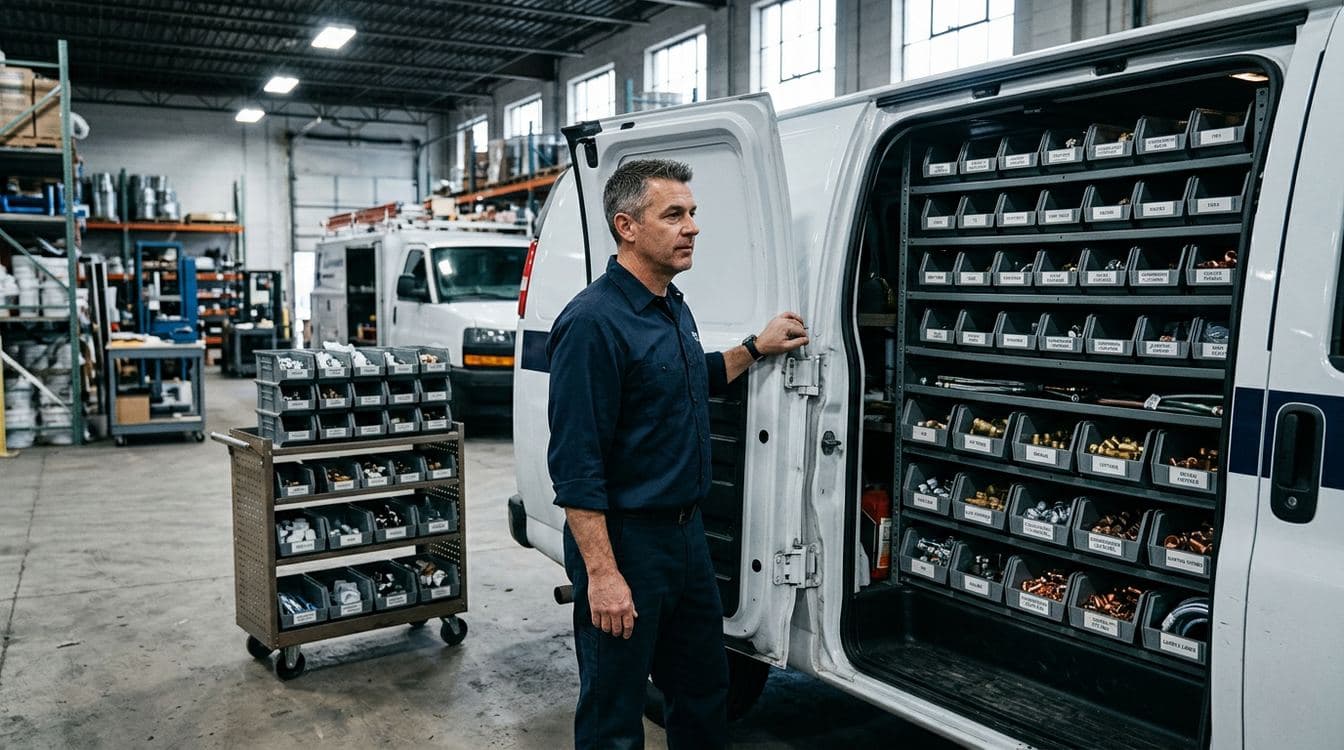
The reflex is to stock the trucks heavier. Carry more parts, fewer second visits.
It does not work the way operators think it does. Carry less than $2,500 in parts and re-rolls eat the calendar. Carry more than $5,000 and dead inventory parks on a truck depreciating instead of selling at the supply house. Most $50M plumbing operators have at least one truck where the under-bench bin has not been opened in eight months.
Aberdeen wrote it bluntly in 2013, and it still holds: "100% first-time fix might not be the ideal state if that means the adoption of stop-gap measures such as bigger trucks or larger truck stock, leading to ballooning service costs and lower profitability. Best-in-class consistently operate at a near-90% level while continuing to yield extremely high service margins."
Oak Creek Plumbing in Wisconsin runs seven service trucks at roughly $8,000 in parts per truck, with a full mockup of the J&M Truck Bodies bin layout sitting in the warehouse. Every Thursday during the weekly tech meeting, one truck swaps its bins for a fresh, fully-stocked set. Thirty minutes per truck. The parts list was built with PHCC's Quality Service Contractors program. The key move was not loading the trucks heavier. The key move was making the stock standard across every truck, so the call-taker and the dispatcher could rely on what was where.
That is the Al Levi creed from PM Magazine: "80% of the time, with 80% of what you need." Not 100% of everything. The other 20% gets pre-staged through a parts runner or scheduled in for a planned second visit the customer expects.
Triage is worth more than truck stock
If you only had budget for one move, you would spend it on the call-taker, not the truck.
The Aberdeen finding is the cleanest number on this. A shop with triage: 86% first-time fix. A shop without it: 62%. That is a 24-point gap from a 10-minute conversation at the front of the call.
The triage step does three things. It captures the model and serial number of the asset, so the dispatcher can pull service history. It surfaces the symptom pattern the customer is actually describing (intermittent, location-specific, time-of-day), which the dispatcher can match against the previous techs' notes. And it screens for second-tech access: is there a roof key, is the boiler-room locked, will the facility be open after 3pm.
This is the piece that is hardest to standardize, because the call-taker is often the receptionist who picked up the phone when the dispatcher was already on another line. Move the triage step into a structured intake form with about 12 questions, train against it for two weeks, and the second-roll rate drops before any technician changes anything in the field.

Commercial is harder than residential, and the customer is unforgiving
Residential plumbing service calls average smaller tickets, denser routes, and a customer who will tolerate a second visit on a Tuesday morning. Commercial is different.
Pulse RevOps' commercial plumbing KPI benchmark pegs the callback target under 4% on service work and under 2.5% on new-construction warranty work. The reason is not technical, it is commercial. A spike in callbacks across a single GC's portfolio, or across a facility-management company's accounts, is the single most reliable predictor that the next bid invitation will not come. Facility managers track this. GCs track this. The bid you lose six months from now traces back to a Tuesday this March when the tech showed up twice for the same drain at the same hospital.
That dynamic gets ignored on the ops dashboard. The dashboard is showing first-time fix rate trending sideways, calendar utilization at 78%, callback dollars looking flat. The customer-facing number, the one that decides whether your name is on next year's bid list, is invisible to the dashboard until the bid list arrives without you on it.
The math at $50M
Here is what 25% costs a real operator.
Take a $50M commercial plumbing contractor running 20 service techs and 400 service calls per month. Industry average puts callback rate at roughly 25%, so 100 of those calls come back. ACCA's worked number for a fully-loaded callback (tech time, truck cost, missed billable opportunity) is around $650.
That is $65,000 a month in pure callback drag. $780,000 a year. The Aquant 2025 benchmark says failed visits represent 25% of total service cost at industry average, 44% at bottom-quartile shops. Level CFO's worked example for a 20-tech shop at 20% callback rate lands at $470,000 a year. Same order of magnitude.
The opportunity cost is harder to write down. If your dispatcher is holding open four return visits next Tuesday, that is four slots that cannot be sold to a new customer who would pay full freight. Commercial plumbing's growth ceiling is rarely the marketing budget. It is calendar inventory.
What the named contractors actually changed
Mr. Drain Plumbing's case study with ServiceTitan reports field-tech efficiency up 220% and EBITDA from 18% to roughly 30% after they standardized the pricebook, the dispatch process, and the truck stock. Same revenue, leaner team. Rainforest Plumbing in Phoenix added $10M in revenue and 20 trucks over four years on the same platform, with their ops director's framing: "you cannot know where you want to go unless you know where you are." The instrumentation came first.
The pattern across both case studies is the same as the Aberdeen pattern. Nobody fixed the second truck roll by making the technician better. They fixed it by making the information that reached the technician better.
FAQ
What is a good first-time fix rate for commercial plumbing? 85% or higher on service work, and 97.5% or higher on new-construction warranty work (callback under 2.5%). Industry average sits at 76-77%. Below 70% is the warning zone, and that is where most mid-market operators land before they instrument the workflow.
What does a second truck roll actually cost? $250 in pure dispatch labor at the low end. $650 fully loaded by ACCA's math (tech time, truck cost, opportunity cost). $1,000 or more once you factor in lost calendar capacity. For a $50M operator running a 25% callback rate, expect $400K-$500K in direct annual drag before opportunity cost.
Should we just stock the trucks heavier? Probably not. Above $5,000 per truck, inventory depreciates faster than it gets used. The Al Levi creed (80% of the time, 80% of what you need) is the right anchor. Standardize the truck stock across every truck first. Then build a fresh fully-stocked bin set the service manager can swap in during weekly tech meetings.
Where does triage fit? Aberdeen's data is clean on this: 86% first-time fix with triage, 62% without. A 12-question structured intake form covering model and serial, symptom pattern, and access constraints will lift the rate before any field change. Triage is the single move with the biggest lift, and the cheapest.
Where this lands
The 30% number tells you what your service ops look like to the customer, not what they look like on a dashboard. The dashboard might show you 76% first-time fix and a clean week. The customer remembers the Tuesday return visit at the hospital. The facility manager taking notes during the bid for next year remembers it twice.
If you want to look at where your second truck rolls are actually coming from across the last 90 days, and what the first move on triage or truck stock would be at your shop, book 30 minutes with us at granular.to. We have spent enough time on commercial plumbing service ops to know which of the four causes is going to be the biggest piece of your number before you tell us.
Keep Reading
- Why Most HVAC Callbacks Come From the Same Three Techs. A parallel pattern from the HVAC service side, where the callback distribution is not random.
- Why Field Service Scheduling Breaks Past 25 Technicians. Where dispatch fails when the headcount crosses a threshold, and what to fix first.