Why Field Service Scheduling Breaks Past 25 Technicians
Most field service companies hit a scheduling wall around 25 techs. The fix is not better software. It is better process.
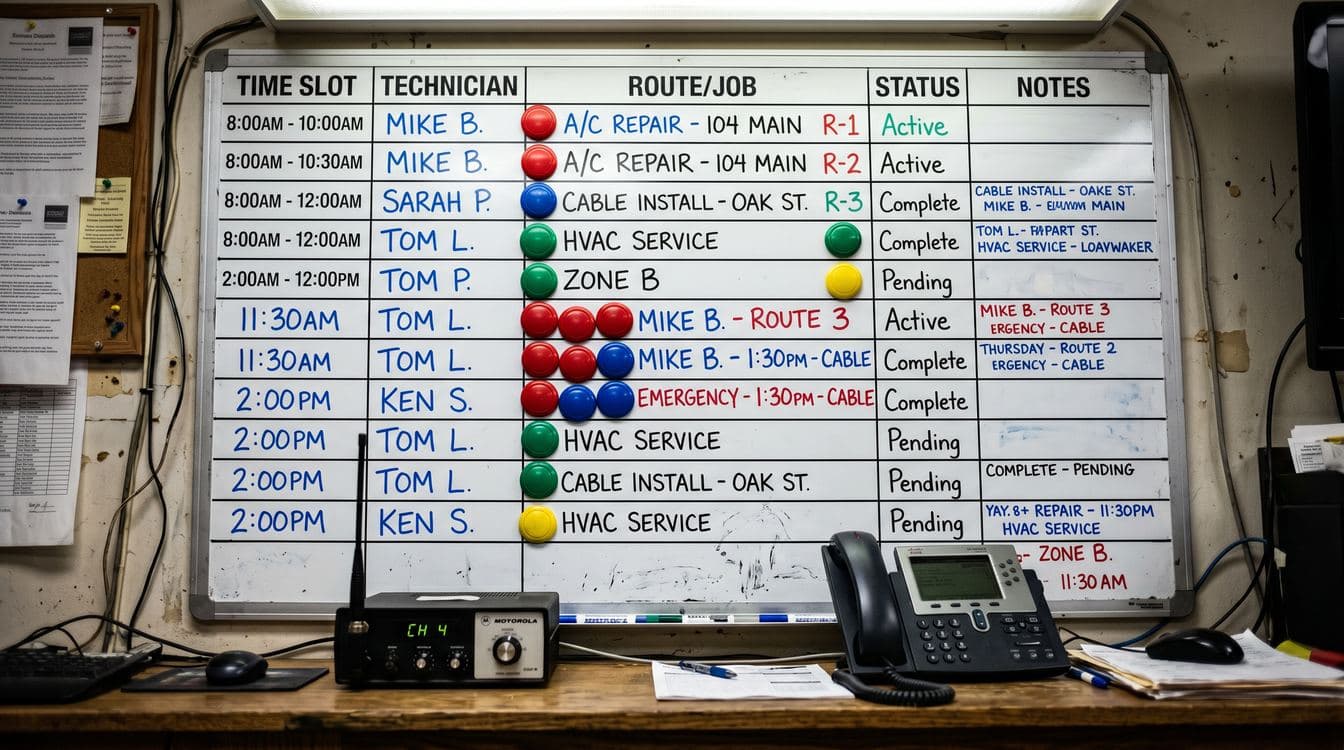
TL;DR. Field service scheduling works fine at 12 techs. Somewhere around 25, the wheels come off. The problem is rarely your software. It is the process underneath: the dispatcher carrying everything in her head, the lack of emergency capacity reserves, the skill matrix that does not exist, and the sales-to-dispatch handoff that still runs on sticky notes. Fix these five process gaps first. Software amplifies whatever process you already have, good or bad.
Your scheduling is not broken because you picked the wrong platform. It is broken because your dispatcher is a single point of failure, your emergency calls hijack the entire day's route, and nobody wrote down which techs are certified for which equipment. That is not a technology problem. That is an operations problem, and it has a predictable inflection point: somewhere between 20 and 30 technicians on the board.
We see this pattern constantly across HVAC contractors, plumbing outfits, and commercial field service companies in the $30M to $70M range. The operation runs smooth at a dozen techs because one sharp dispatcher can hold the whole picture in her head. Then you grow, and the cracks show up fast.
The 25-Tech Inflection Point
The math is straightforward. One experienced dispatcher can effectively manage 10 to 15 technicians without software assistance. That is the practical ceiling before quality degrades, according to BuildOps' field service benchmarks. Beyond that range, the dispatcher starts making tradeoffs she does not even realize she is making: sending the closest tech instead of the right tech, stacking jobs too tight, forgetting that Unit 7 needs a specific refrigerant certification.
At 25 techs, those invisible tradeoffs become visible problems. First-time fix rates drop (the industry average sits at 75%, but companies in this transition zone often dip into the 60s). Overtime spikes. Customer callbacks increase. And the dispatcher, the person who held it all together, starts burning out.
The field service management software market is projected to hit $9.2 billion by 2030, and every vendor will tell you their platform solves this problem. Some of them are right. But software layered on top of a broken process just automates the dysfunction.
Five Process Failures That Break Before Software Can Help
1. The dispatcher is the database
In most field service operations under 20 techs, one person knows everything: which tech has the van with the 20-foot ladder, who is certified for commercial chillers versus residential splits, who called in sick, and which customer's dog bites. That knowledge lives nowhere except her memory.
When that person takes a vacation, calls in sick, or (increasingly) retires, the operation loses its operating system overnight. This is the same tribal knowledge problem that hits every mid-market business, but in field service it shows up on a daily dispatch board instead of a quarterly report.
The fix is not a $300/month/tech FSM platform. The fix is documenting what she knows: a shared skill matrix, a territory map, customer notes that live in a system instead of a spiral notebook.
2. No emergency capacity reserve
Most field service operations schedule to 100% capacity. Every tech has a full board, every slot is filled. Then a commercial customer calls with a chiller down, and the entire day's schedule gets blown up.

The math on this is punishing. A $50M HVAC contractor running 30 techs at an average billing rate of $150 per hour loses roughly $280,000 to $420,000 annually in idle time and rework caused by emergency rescheduling, according to industry benchmarks from SMACNA.
The standard practice in well-run operations: hold 15% to 20% of daily capacity as emergency reserve. That means if you have 30 techs, four to six of them start the day with lighter boards. Yes, you sacrifice some utilization. But you stop the cascade effect where one emergency call displaces four scheduled appointments.
3. The skill matrix does not exist
Ask a dispatcher which techs can work on VRF systems and she will name them from memory. Ask her to produce a list, and she cannot. This is not a character flaw. It is the predictable result of growing an operation without formalizing what people know.
The Bureau of Labor Statistics projects 8% employment growth for HVAC technicians through 2034, with about 40,100 new hires needed annually. The workforce is getting younger and less experienced: ACCA reports a nearly 30% enrollment spike in HVACR two-year programs. That means more techs with narrower skill sets entering your operation every year.
Without a documented skill matrix, the dispatcher defaults to sending whoever is closest. The result: a first-year tech shows up to a commercial VRF install he is not qualified to touch, the customer calls back, and you eat the cost of a return visit.
Build the matrix in a spreadsheet. It takes half a day. Update it quarterly. You will see scheduling accuracy improve before you spend a dollar on software.
4. Sales-to-dispatch handoff runs on sticky notes
The sales team closes a job. They write the address, the scope, and maybe a few notes on a piece of paper (or worse, send a text message) and hand it to dispatch. The dispatcher copies it onto the board. Details get lost in translation: the customer wanted the work done on a Saturday, the access point is around back, the building has a freight elevator that requires a 24-hour reservation.
This handoff failure is invisible in most reporting because nobody tracks "jobs delayed due to incomplete dispatch information." But field service companies that do track it typically find 10% to 15% of jobs require a follow-up call or site revisit because of missing handoff details.
The fix is standardization: a one-page intake form (digital or paper) that sales completes before dispatch accepts the job. Non-negotiable fields: site access instructions, equipment specifics, customer schedule constraints, required certifications. If the form is incomplete, dispatch sends it back. Simple, and it costs nothing.
5. No feedback loop from the field
Technicians know things dispatchers do not: the parking lot that takes 20 minutes to navigate, the customer who always adds scope on-site, the equipment that needs a part nobody stocks in the van. In most operations, that information never makes it back to dispatch in a structured way.
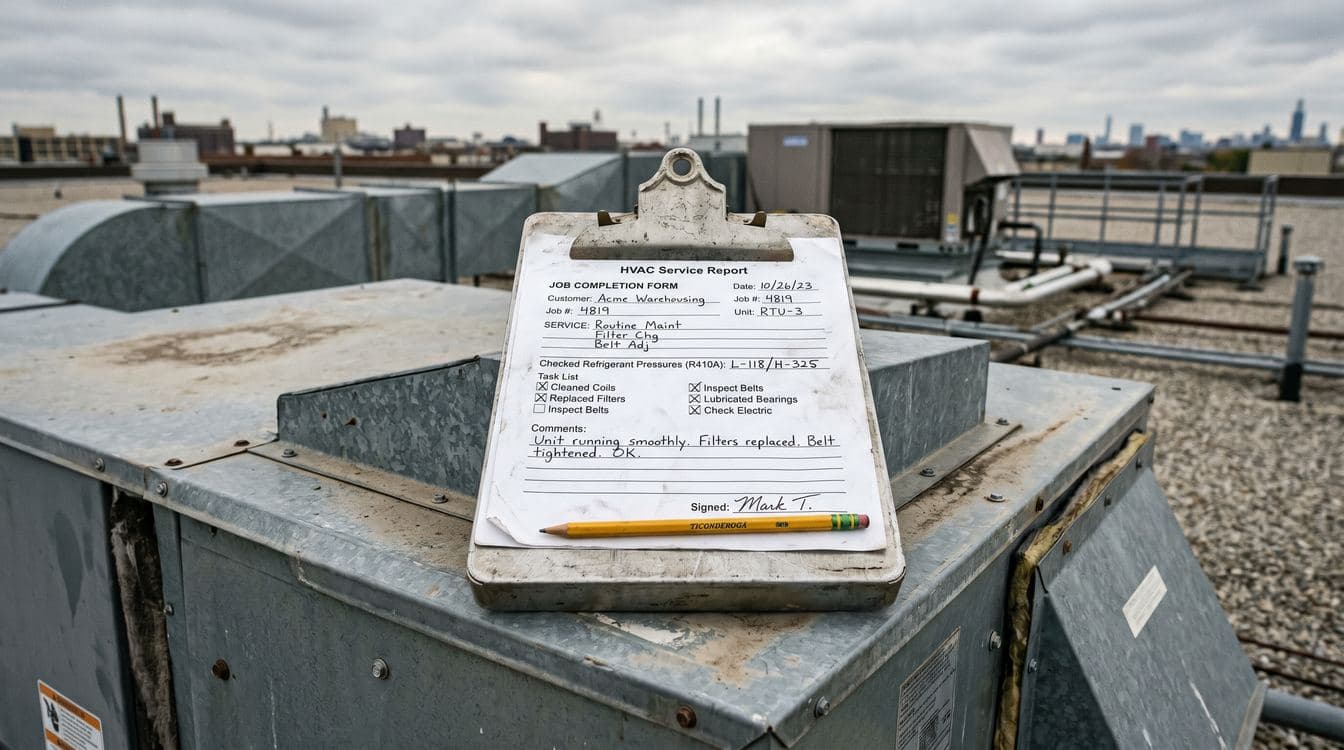
Without a feedback loop, dispatch keeps making the same allocation mistakes. The tech keeps losing 30 minutes to the same parking lot. The same customer keeps blowing up the schedule with add-on work. The same part keeps not being in the van.
Build a 60-second end-of-day debrief: one question per job. "Anything dispatch should know for next time?" Aggregate those notes monthly. Patterns emerge fast, and they are patterns no FSM vendor's algorithm can detect because the data does not exist in any system.
When Software Actually Earns Its Cost
None of this means software is worthless. It means software is the second step, not the first.
| Company Size | Process Maturity | Right Tool | Estimated Monthly Cost |
|---|---|---|---|
| Under 15 techs | Documented skill matrix, standard handoff form | Google Calendar + shared spreadsheet | Free to $50 |
| 15 to 30 techs | All five process fixes in place | Mid-tier FSM (FieldEdge, Housecall Pro) | $100 to $150 per tech |
| 30 to 60 techs | Process-mature, ready to optimize | Commercial FSM (ServiceTitan, BuildOps) | $245 to $500 per tech |
| 60+ techs | Multi-location, complex routing | Enterprise FSM (ServiceMax, IFS) | Custom pricing |
The jump from a shared spreadsheet to a $300/tech/month platform only makes sense when your processes are already documented and your team is already following them. ServiceTitan does not fix a broken handoff form. BuildOps does not create a skill matrix. Those tools optimize processes that already work.
FAQ
At what point should a field service company invest in FSM software? When you have documented processes (skill matrix, handoff forms, emergency reserves) and your dispatchers are still hitting capacity limits. For most operations, that is somewhere between 15 and 25 techs.
What is a good first-time fix rate for HVAC contractors? The industry average is 75%. Well-run operations with proper skill-based dispatching hit 85% to 90%. If you are below 70%, the problem is almost certainly skill-mismatch dispatching, not technician competence.
How many techs can one dispatcher manage effectively? Without software, 10 to 15. With a mid-tier FSM and documented processes, 25 to 40. The range depends entirely on job complexity and geographic spread.
What does poor scheduling actually cost a field service company? For a 30-tech operation, expect $280,000 to $420,000 annually in idle time, rework, and overtime caused by reactive scheduling. That does not include lost revenue from customer churn.
The next time you are tempted to evaluate field service software, run through these five process checks first. If your dispatcher's knowledge is not documented, your emergency protocol does not exist, and your sales-to-dispatch handoff is still verbal, no platform will save you. Fix the process. The software will be there when you are ready.
If field service scheduling is the thing keeping you up at night, book 30 minutes with us. Granular builds focused tools for mid-market field service and HVAC operations: fixed price, four weeks, working tool.
Keep Reading
- Your Quoting Process Is Costing You Jobs. Here Is the Fix.. A step-by-step workflow for cutting quote turnaround from days to hours, whether you are a GC, HVAC contractor, or specialty trade.
- How to Capture Tribal Knowledge Before Key People Leave. The dispatcher problem in this post is one case of a bigger pattern: key-person risk. This post covers the full playbook for getting institutional knowledge out of people's heads.