Why Your HVAC Dispatch Board Is Wrong by 10 AM
Your dispatch board looks perfect at 7 AM. By 10, emergency calls and callbacks have rewritten it. The real system is your dispatcher's head.
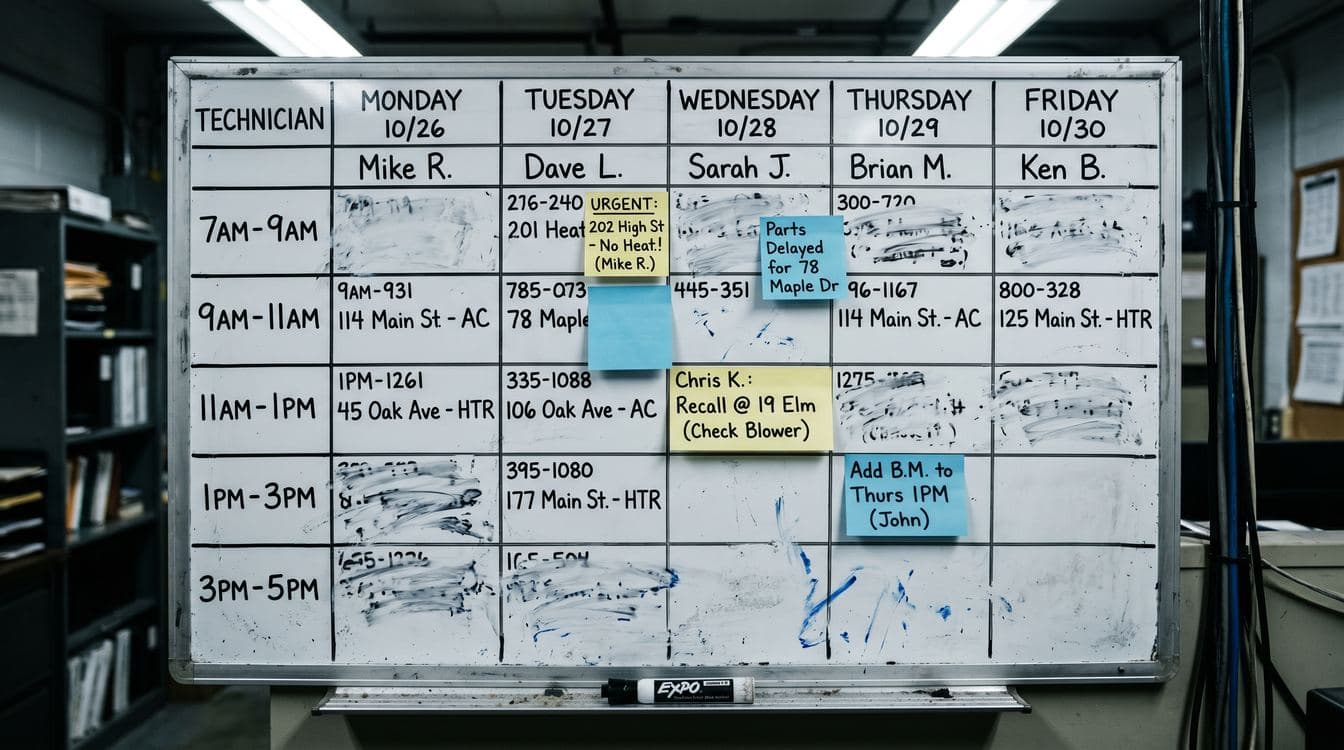
Your HVAC dispatch board is a plan, not a picture of reality. By mid-morning, emergency calls, callbacks, parts shortages, and truck breakdowns have reshuffled everything. The real dispatch system is your dispatcher's phone, her memory, and the mental model she carries about every tech, every truck, and every customer. If she leaves, you do not lose a dispatcher. You lose the operating system.
The board was clean at 7 AM. By 10, it is a fiction.
That gap between the plan and what is actually happening in the field is not a technology problem. It is not a scheduling problem. It is a structural one, and it shows up in every $40M-$70M HVAC operation we have worked with. The dispatch board is where your day starts. The dispatcher's head is where your day actually runs.
What the Board Looks Like at 7 AM
At the start of any service day, the board looks like a solved puzzle. Routes are tight. Techs are slotted to jobs that match their certifications. Maintenance calls are batched by zone. Installs have two-person crews. Somebody blocked a two-hour window for a commercial walk-through that has been on the calendar for two weeks.
It is satisfying. It looks like control.
Then the phones open.
Five Things That Destroy Dispatch Plans Before Lunch
This is not a bad day. This is a normal Tuesday in peak season.
1. Emergency calls.
HVAC call volume during summer peaks at roughly 340% above spring baseline. Those calls do not arrive evenly across the day. They stack up in the morning. A no-cool call on a pediatric dental office does not wait for the 2 PM slot you had penciled in for routine maintenance. It goes to whatever tech is closest, available, and certified, which means somebody else gets bumped, rerouted, or dropped.
2. Callbacks from yesterday.
Industry data puts the average first-time fix rate at around 75-80%, which means roughly one in four or five service calls comes back. When that callback hits the board at 8:30 AM, your dispatcher is not just inserting a new job. She is deciding whose morning gets disrupted, which customer gets a later arrival window, and whether the original tech should go back or if a different one is closer. That is a judgment call, not a data entry task.
3. Parts that are not where they are supposed to be.
The work order says the part is on the truck. The tech calls from the job site: it is not. Now the dispatcher is cross-referencing two warehouses, one supplier, and three other trucks to find a common part that should have been stocked three days ago. The Aberdeen Group identifies insufficient or incorrect parts on-site as the leading cause of repeat visits, accounting for 51% of callbacks. Parts problems eat dispatch time every single day.
4. Truck breakdowns.
A truck out of service mid-route does not just strand one tech. It potentially grounds two or three jobs depending on what that truck was carrying and who was next on its route. The dispatcher now reassigns jobs across a roster that was already fully loaded.
5. Customer reschedules.
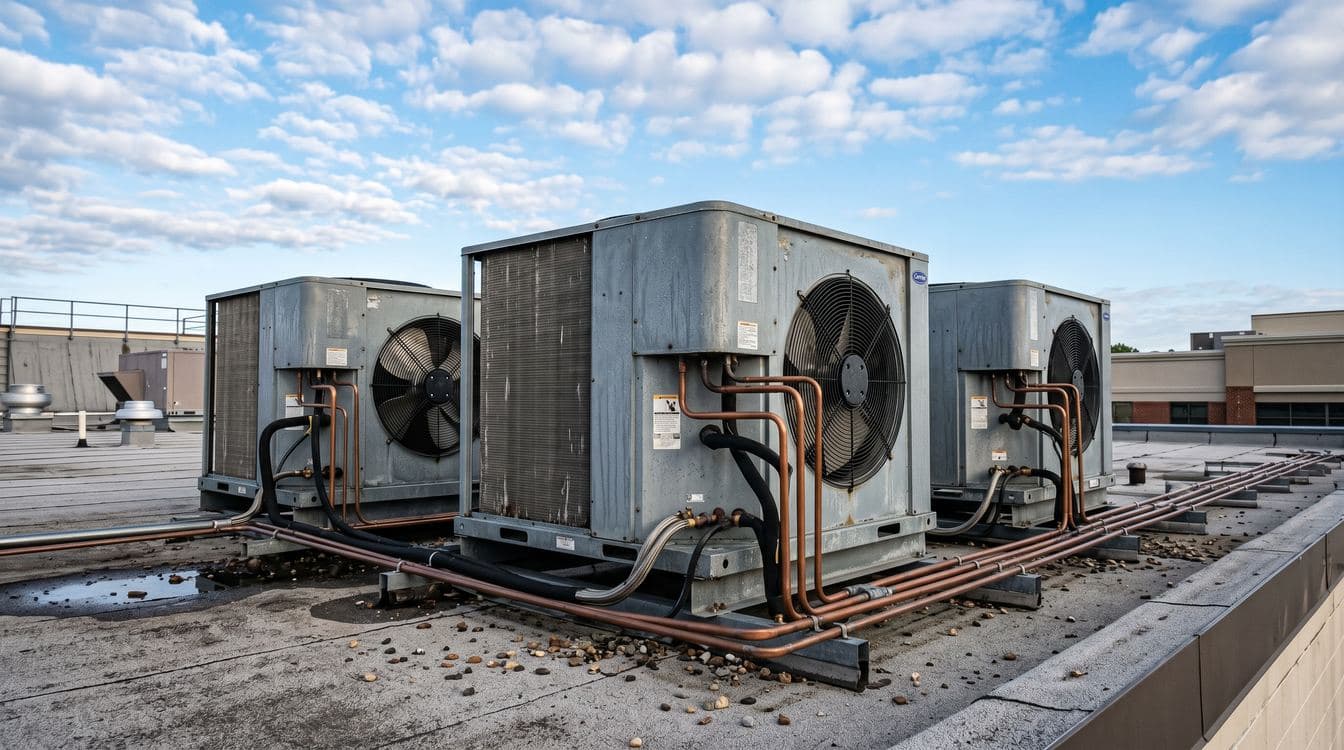
A commercial property manager calls at 9 AM to push a rooftop unit inspection from today to Thursday. Fine. Except that job was a bridge between two routes. Now the afternoon routing has a gap that has to be filled or written off as dead drive time. The dispatcher fills it from a mental waitlist of customers who asked to be called if something opened up.
None of these are surprises. They are the standard texture of an HVAC service day. The board does not know how to handle them. Your dispatcher does.
Your Dispatcher Is the Real Operating System
"She knows which tech cannot go to that customer because of what happened six months ago. She knows which truck has the 410A left. She knows the commercial accounts that will escalate if they do not get a call by noon. None of that is in the software."
That is a paraphrase from a conversation with an owner running 28 techs in the mid-Atlantic. He was not complaining. He was explaining reality.
The ACCA 2025 Contractor of the Future Study found that 56% of HVACR contractors have field service management software, but most treat it like a glorified QuickBooks, using it primarily for invoicing. The scheduling module is there. The dispatch board is there. But the real dispatch intelligence, the layer that knows which tech is best for which customer and which job, lives in the dispatcher's head.
That is not a knock on software. It is an honest description of what the software cannot see without explicit input. The software does not know that a particular commercial account will complain to the owner directly if their tech shows up past 9 AM. The software does not know that a tech had a rough callback with a homeowner last week and should probably not return to that address. The software does not know that one of your best techs has a slow afternoon because his truck needs a water pump and you are babying it until Friday.
Your dispatcher knows all of it.
She is routing, triaging, translating, and absorbing real-time information from eight directions at once. She is the operating system. The board is just the display.
What Happens When She Leaves
This is the conversation most owners avoid until it is too late.
The HVAC industry faces a shortage of roughly 110,000 technicians, and most of the workforce-planning conversation centers on field labor. But the dispatcher is a single point of failure with no backup plan at most contractors in the $40M-$70M range. When she takes a vacation, operations get shaky. When she quits, operations can genuinely stall.
The institutional knowledge she carries includes things like:
- Which accounts have SLA windows that trigger penalties
- Which techs can handle complex commercial jobs unsupervised
- Which customers need a courtesy call before arrival or they will not be home
- Which parts suppliers will do same-day delivery if she calls before 10 AM
- Which jobs are always underestimated in the system and need an extra hour buffered in
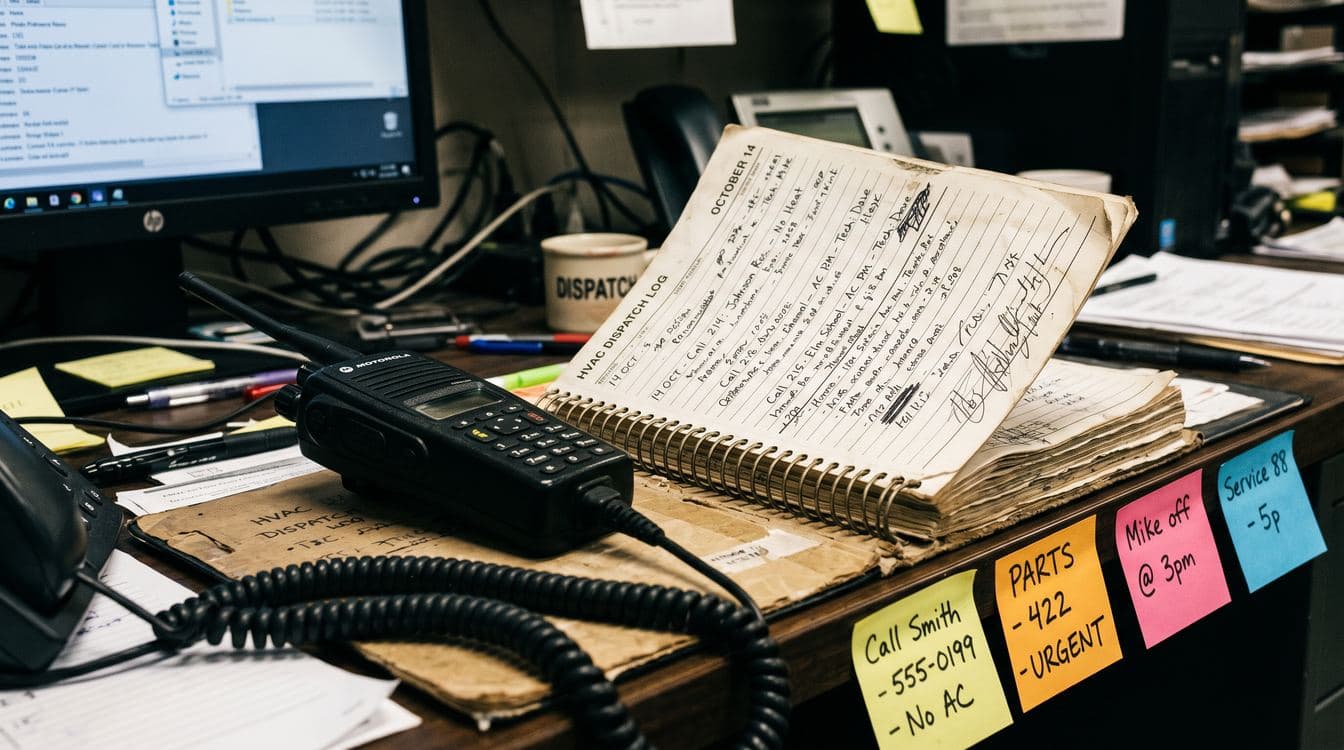
None of that is in your CRM. None of it is in your field service software. It is in her notes, her phone, and her memory.
When she leaves, her replacement does not just need to learn the software. They need to rebuild months of operational intelligence from scratch. In the meantime, callbacks go up, on-time arrival rates go down, and a handful of commercial accounts start calling you directly.
We have written about this risk in more depth in how to capture tribal knowledge before key people leave. The dispatcher is the canonical example of the problem.
Where Tools Actually Help
Software does not replace the dispatcher's judgment. It removes the parts of her job that are pure information-retrieval so she can spend her time on the judgment calls.
A few places where tools genuinely reduce the divergence between the board and reality:
Real-time GPS and job status updates. When a tech completes a job and the system updates automatically, the dispatcher does not have to call to find out where he is. She can see it. That alone cuts a meaningful slice of her incoming call volume.
Parts inventory integration. If the dispatch board can surface what is on each truck and in each warehouse before a tech is routed to a job, the parts-mismatch callback rate drops. This is one area where ERP inventory accuracy matters directly to field operations.
Skill-based routing logic. When the system knows each tech's certifications and restricts certain job types accordingly, the dispatcher is not manually filtering for who can legally work on a commercial chiller versus a residential mini-split.
Automated customer notifications. When ETAs and arrival windows go out by text without the dispatcher having to make that call, she is freed up for the reactive work that requires actual judgment.
What tools do not replace: the mental model of relationships, history, and context that makes HVAC dispatch more than a routing problem. As ServiceTitan's own dispatching guidance notes, the dispatcher is the "air traffic controller" of the business, a description that implies a human with situational awareness, not a software function.
The Scaling Problem
The dispatcher's mental model works at a certain crew size. At 10 techs, one experienced dispatcher can hold the whole picture in her head. At 25, it starts to crack. We have written about exactly where that threshold sits and what changes operationally once you cross it.
What breaks is not the board. What breaks is the single person who was reconciling the board with reality. The answer is not a better board. It is building the systems, documentation, and software integrations that distribute the knowledge she was carrying alone.
That work has to start before she leaves, not after.
FAQ
Why does my HVAC dispatch board fall apart so quickly every day?
The board reflects a static plan built before the day's variables arrive. Emergency calls, callbacks, parts shortages, and truck issues start hitting from 7 AM onward. Each one forces a re-sort of the whole day. Without a system that updates in real time and captures the reasoning behind each change, the board stops reflecting reality within a few hours.
What is a realistic first-time fix rate for an HVAC service company?
Industry benchmarks from Aberdeen Group put the average first-time fix rate at 75-80%, meaning one in four or five jobs requires a return visit. Best-in-class operations achieve 88% or higher. If your callback rate is above 20-25%, the root causes are typically parts availability, technician skill mismatches, or insufficient job information at dispatch.
How do I reduce emergency call disruptions to my dispatch schedule?
The most effective approach is triage at intake. Categorize calls by urgency before they hit the board, maintain a short list of technicians with flexible routing for true emergencies, and build buffer time into the daily schedule rather than optimizing for a perfectly full board. A board with no slack cannot absorb the day's first unplanned call without cascading.
What happens when my dispatcher quits or goes on leave?
In most HVAC operations at the $40M-$70M level, the dispatcher carries critical institutional knowledge: customer preferences, account-specific SLAs, technician skill nuances, supplier contacts, and historical job patterns. None of that typically lives in software. When she leaves, her replacement has to rebuild that knowledge through trial and error, and your operations performance dips in the meantime. The fix is documentation and knowledge capture before the departure, not after.
What HVAC dispatch management software actually helps with?
Software best addresses the information-retrieval parts of dispatch: GPS status, parts inventory, customer contact history, job notes, and skill-matching filters. It reduces the time a dispatcher spends on phone calls just to confirm where a tech is. What it does not replace is judgment: understanding customer relationships, knowing which jobs run long, and making calls when conflicting priorities hit simultaneously.
If you are working through how to structure dispatch operations for scale, the discovery call is where we start. Granular works specifically with HVAC and field service contractors navigating the gap between their current systems and the operational infrastructure a growing company actually needs.
Keep Reading
- Why Field Service Scheduling Breaks Past 25 Technicians: What changes when your crew outgrows a single dispatcher's memory and the whiteboard stops scaling.
- How to Capture Tribal Knowledge Before Key People Leave: A step-by-step process for documenting the operational knowledge your best people carry in their heads.