What AI Actually Costs for a 20-Person Shop
AI vendors quote $150K. Your shop does $8M in revenue. Here is what AI realistically costs, what it doesn't, and where the money actually goes.

TL;DR. Most AI pricing guides are written for companies with dedicated IT departments and seven-figure technology budgets. If you run a 20-person shop doing $5M to $15M in revenue, those numbers are useless. Realistic AI costs for your size range from $5,000 for off-the-shelf tools to $25,000 to $60,000 for custom-built solutions that actually fit your workflow. The real cost isn't the software. It's the time your team spends learning it, the integration work nobody quotes upfront, and the ongoing adjustments after launch. This post breaks down where the money actually goes.
You've read the articles. "AI is transforming manufacturing." "Companies using AI see 30% productivity gains." Then you look at the price tag from the vendor who cold-emailed you last Tuesday, and it's $150,000 for a "comprehensive AI solution" that requires six months of implementation, a full-time data engineer you don't have, and infrastructure changes to systems that are working fine.
You close the email. You go back to quoting jobs.
That reaction is completely rational. The problem isn't that AI is too expensive for your shop. The problem is that most AI pricing is built for companies ten times your size, and nobody bothers to translate it down.
The pricing landscape is designed to confuse you
The AI vendor market has a transparency problem. According to a 2026 guide from Dan Cumberland Labs, 85% of organizations miss their AI budget forecasts by more than 10%, and actual costs typically run three to five times higher than initial vendor quotes. That $50K project? You're probably looking at $150K to $200K when everything shakes out.
But those numbers come from mid-market and enterprise deployments: companies with 200 employees, dedicated IT teams, and existing data infrastructure. When a pricing guide says "AI implementation starts at $100K," they're talking about a different planet than the one where you run a 20-person millwork shop or HVAC contracting business.
Here is what the landscape actually looks like for shops your size.
Three tiers of AI spending for small shops
Tier 1: Off-the-shelf AI tools ($0 to $500 per month)
This is where most small shops should start, and where many will stay permanently. These are existing software tools that have added AI features to things you already pay for:
- Your existing accounting or ERP software adding AI-powered forecasting or anomaly detection. QuickBooks, JobBoss, and Epicor are all rolling out AI features inside their existing subscription tiers.
- Standalone AI writing and communication tools like ChatGPT, Claude, or Microsoft Copilot for drafting customer emails, summarizing job notes, or generating report templates. $20 to $30 per user per month.
- AI-enhanced estimating add-ons that plug into your existing quoting workflow. These pull from historical job data to suggest pricing, flag outliers, and speed up the math you already do.
Total annual cost: $1,000 to $6,000. No implementation project. No consultant. You sign up, you start using it, you decide if it helps.
The catch: these tools are generic. They don't know your vendors, your customers, your equipment quirks, or the markup rules your senior estimator has refined over two decades. They make everyone 10% to 15% faster at tasks that already had a digital workflow. They don't touch the operational problems that actually keep you up at night.
Tier 2: Configured SaaS platforms ($500 to $3,000 per month)
This is the middle tier that gets the most marketing spend but delivers the most inconsistent results. These are industry-specific SaaS platforms (construction project management tools, manufacturing execution systems, inventory platforms) that offer AI modules as add-ons:
- AI-powered scheduling optimization inside your existing project management tool
- Predictive inventory management that forecasts demand based on your historical orders
- Automated customer communication (job status updates, quote follow-ups) triggered by project milestones
Total annual cost: $6,000 to $36,000, plus implementation. And here is where the real number diverges from the quoted number.
The platform itself costs $500 to $3,000 per month. But the implementation: configuring it to match your actual workflow, migrating your historical data, integrating it with your existing systems, and training your team to use it? That's another $10,000 to $40,000 from the vendor's professional services team or a third-party integrator. According to a 2026 manufacturing AI pricing analysis from Stuffsites, the real cost driver is never the AI model itself. It's integration, data preparation, and long-term maintenance.
The risk at this tier: you pay enterprise prices for a tool that's 60% configured to your workflow and 40% forcing you to change how you operate. The AI features work great in the demo. Then you realize your job costing structure doesn't match the platform's assumptions, your field crews won't use the mobile app, and the "predictive" features need 18 months of clean historical data you don't have.
"We spent $28,000 on a platform that was supposed to predict our material needs. It kept recommending orders based on national averages instead of our actual supplier relationships. My warehouse manager still does it better with a spreadsheet and 15 years of experience."
Tier 3: Custom-built AI tools ($25,000 to $75,000)
This is where AI starts solving the problems that are actually specific to your operation. Custom doesn't mean building a neural network from scratch. It means someone builds a tool tailored to your workflow, your data, and your team:
- A quoting assistant trained on your historical jobs, your markup rules, your vendor pricing, and your specific material specifications. Not a generic estimating tool with AI bolted on, but something that thinks the way your best estimator thinks.
- A knowledge capture system that records, transcribes, and structures your veteran employees' expertise into searchable decision trees and process guides. (This is what we covered in our post on how to capture tribal knowledge before key people leave.)
- A job coordination agent that monitors your active projects, flags scheduling conflicts, and alerts your team before problems become expensive.
For a focused, single-workflow tool at a 20-person shop, realistic pricing looks like this:
| Cost component | Range |
|---|---|
| Discovery and scoping | $2,000 to $5,000 |
| Development and integration | $15,000 to $45,000 |
| Testing and deployment | $3,000 to $8,000 |
| Training your team | $2,000 to $5,000 |
| Ongoing hosting and maintenance | $500 to $1,500/month |
Total first-year cost: $28,000 to $75,000, including six to twelve months of hosting. That's a real number. Not a "starting at" that triples during implementation.
The key phrase is "single-workflow." You're not buying an AI platform. You're solving one specific problem that costs you real money every week. If your quoting process takes 6 hours per job and you do 15 quotes a month, and a custom tool cuts that to 2 hours, you just bought back 60 hours of your most expensive employee's time every month. At a fully loaded cost of $45 per hour, that's $32,400 per year in recovered capacity. The tool pays for itself in year one.
Where the money actually goes (and where it's wasted)
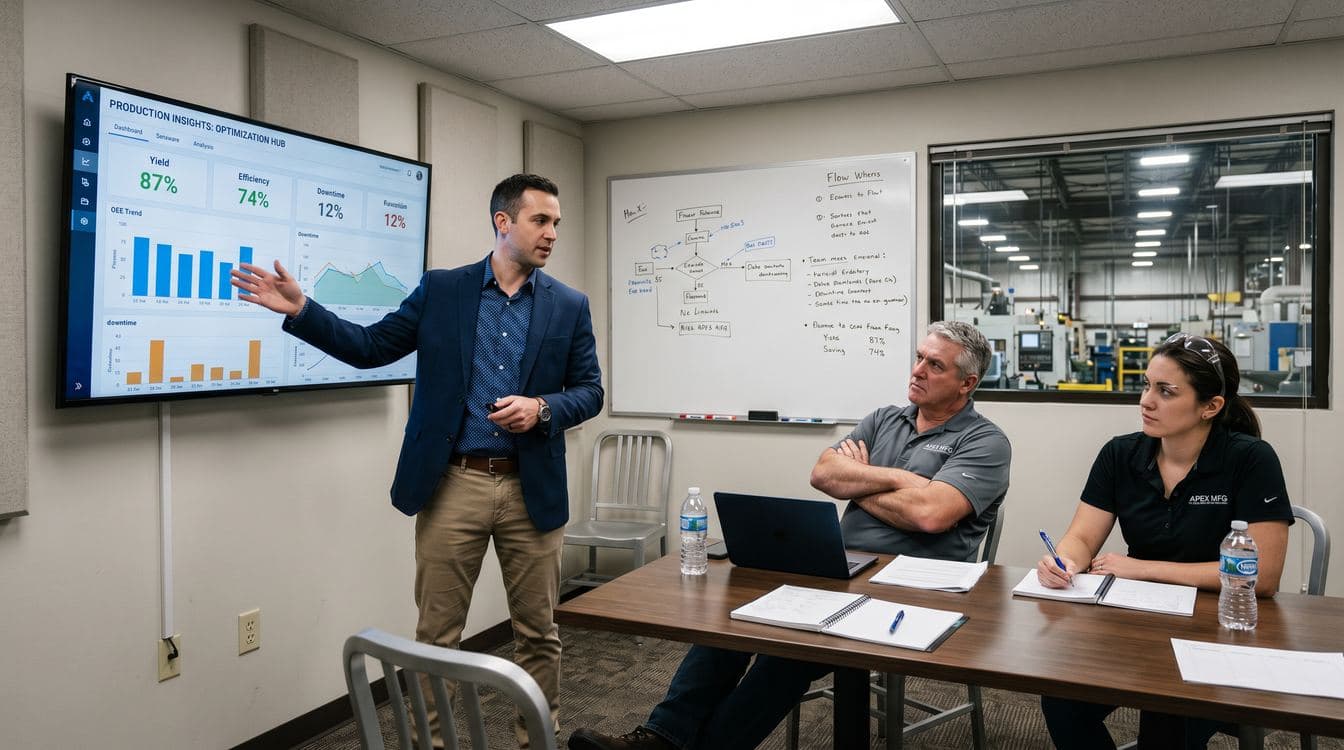
Most AI budget conversations focus on the wrong line item. Here is how the cost actually breaks down for a custom tool at a small shop, based on what we see building these tools:
Data preparation: 25% to 35% of total cost. Your data is in spreadsheets, email threads, handwritten notes, and the heads of your longest-tenured employees. Getting it into a format that an AI tool can use is the largest single cost in most projects, and it's the one most vendors underquote or ignore entirely. Prometheus Agency's transparent cost guide confirms this: the software subscription is the easy number, but data preparation, integration, and change management determine whether the investment delivers a return.
Integration: 20% to 30% of total cost. Your new AI tool needs to talk to your existing systems. Your ERP, your accounting software, your project management tool, your email. Every integration point is a potential failure point and a real cost. Shops that run on a single, well-maintained ERP spend less here. Shops running five disconnected systems spend more.
The actual AI: 10% to 15% of total cost. The models, the training, the prompts, the logic. This is the part vendors emphasize in demos because it sounds impressive. It's the smallest line item in most projects.
Training and change management: 10% to 15% of total cost. Your crew needs to learn the tool, trust the tool, and integrate it into their daily routine. This is where most AI projects die. Not because the technology doesn't work, but because nobody spent enough time making sure the people using it understood why and how.
Ongoing maintenance: 10% to 15% of annual cost. AI tools aren't set-and-forget. Your vendor relationships change, your material prices shift, your processes evolve. The tool needs updates. Budget $500 to $1,500 per month for a custom tool at your scale.
The three questions to ask before spending anything
Before you allocate a dollar to AI, answer these honestly:
1. What specific problem costs you the most money right now? Not "we need to be more efficient." Specifics. "We lose two bids a month because our quotes take four days." "We've had three warranty claims this quarter because of communication gaps between the shop and the field." "Our inventory write-offs are $40,000 a year because nobody tracks what's actually on the shelf." If you can't name the problem in one sentence with a dollar figure attached, you're not ready for AI. You're ready for a process audit.
2. Could a spreadsheet, a checklist, or a better process solve this without AI? Seriously. Many of the problems that operators attribute to "needing better technology" are actually process problems in disguise. Before you spend $30,000 on an AI quoting tool, spend two weeks documenting your current quoting process and identifying where the bottlenecks actually are. Sometimes the answer is a shared spreadsheet with a consistent naming convention and a weekly review meeting.
3. Do you have at least 12 months of historical data for the workflow you want to improve? AI tools learn from patterns in your historical operations. If your quoting data lives in email threads from three different employees' inboxes, or your job cost data is in a filing cabinet in the back office, the first project is data organization, not AI. That project is cheaper, and it makes every future technology investment more effective.
What the "free" AI tools are actually costing you
There's a hidden cost to the free and cheap tier that nobody talks about: time spent experimenting with tools that don't fit.
Every hour your office manager spends trying to make ChatGPT write useful customer follow-up emails is an hour she's not spending on the work that actually moves jobs forward. Every afternoon your estimator spends testing an AI quoting app that doesn't understand your material specs is an afternoon of lost quoting capacity.
According to research compiled by the National Association of Manufacturers, small manufacturers already operate with average profit margins between 5% and 10%. There's no slack in those numbers for technology experiments that don't pay off.
The cheapest AI investment is the one that solves a problem you've already defined, with a tool that's built for your specific workflow, delivered on a timeline and price you agreed to upfront. Everything else is exploration, and exploration has a cost even when the software is free.
The honest answer
Here's the bottom line for a 20-person shop:
- Start with $0 to $500 per month on AI features inside tools you already use. See if the generic capabilities move the needle.
- If they don't, identify your single most expensive operational problem and get a fixed-price quote to solve it. Expect $25,000 to $60,000 for a focused custom tool. Demand a fixed price and a fixed timeline.
- Skip the $100K+ "comprehensive AI transformation" packages. Those are built for companies with 200 employees and a CTO. You need a tool that works, not a platform that promises everything.
The shops that get the most from AI in 2026 aren't the ones spending the most. They're the ones who started with a specific problem, found a builder who understood their operation, and got something working in weeks, not months.
If you've identified the problem and you want a straight answer on what it would cost to solve, that's the conversation we have at Granular. Fixed price, four weeks, working tool. Book 30 minutes and we'll tell you whether AI is the right answer or whether a simpler fix gets you there faster.