Three Project Setup Patterns at $40M Engineering Firms
Three patterns we keep finding when building tools for $40M engineering firms. Why project setup decisions made in week one cost margin all year.

TL;DR. Three patterns show up in every mid-market engineering firm we have helped: a work breakdown structure that splits estimating from billing, billing terms set at the wrong WBS level, and resource plans living in a spreadsheet no one trusts. Each pattern looks like a small administrative annoyance in week one of a project. By month three it is eating two to four points of margin and forcing the principal to rebuild the EAC by hand the night before a partner meeting. None of these are software problems. They are decisions made before the project kicks off, made by people who do not talk to each other.
A $60M structural engineering firm called us last spring because their Deltek Vantagepoint EAC reports were "always wrong." That was not the actual problem. The actual problem was that their estimators built proposals in one phase structure, their PMs ran jobs in a different one, and their controller invoiced clients off a third. Three structures, three sources of truth, one EAC nobody believed.
We have now built tools or run process work for several mid-market engineering firms in the $40M to $80M revenue band. Civil, structural, MEP. Every single one had a version of the same three patterns in their project setup. This piece is the field notes.
Pattern one: the WBS that splits estimating from billing
Every engineering firm has a work breakdown structure. The question is whether one WBS runs from proposal through closeout, or whether three different WBS structures live in three different systems and the firm pretends they are aligned.
Three is what we usually find.
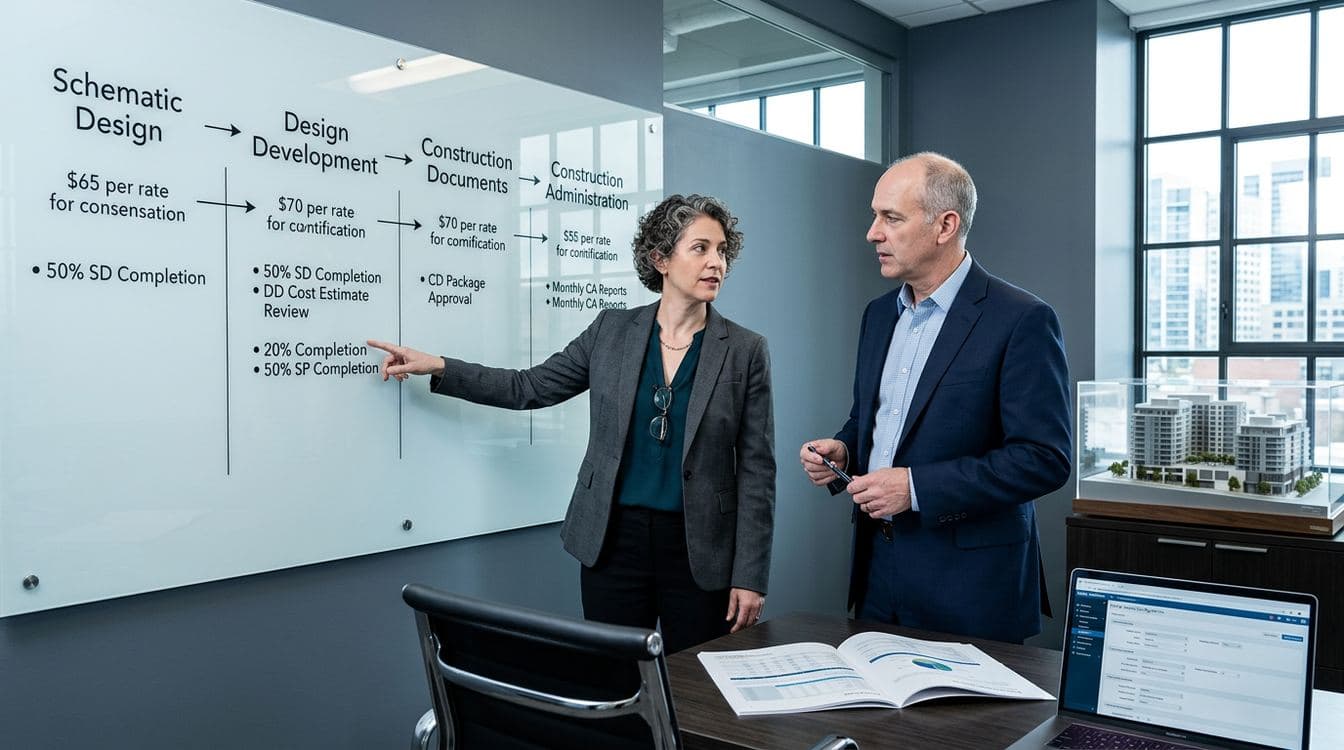
The estimator builds the proposal in a spreadsheet. Schematic Design, Design Development, Construction Documents, Construction Administration. Maybe 25 lines, with hour allocations per discipline. The PM accepts the project and rebuilds it in the PM system, this time with internal task codes for civil structural drainage, structural framing, structural connections, and so on. The codes do not map cleanly to the proposal phases. The controller, meanwhile, sets up billing in a fourth structure aligned to the client's contract milestones, which are themselves a fifth structure tied to the client's funding gates.
By the time hours land on the time sheet, the PM is sorting them into one set of codes. The accountant is invoicing against another. The EAC report rolls up by yet a third. Nobody is wrong individually. Together they produce a number that does not tie out.
The 47th Annual Deltek Clarity A&E Study of 896 firms found that 28% of firms cite "accurate project cost and timeline forecasting" as a top project management challenge, and 23% cite "insufficient or poorly executed PM procedures." The Deltek webinar deck calls out "establishing and implementing project management accountability metrics" as the number one internal initiative for 2025. These are not software complaints. They are WBS complaints.
The fix is boring. Pick one work breakdown structure at proposal time. Insist that the estimator, the PM, and the controller agree on it before the project is set up in any system. Lock it. If the client's contract demands a different invoice structure, build a mapping table once, in one place, instead of letting three teams improvise their own.
Firms resist this because the estimator wants flexibility, the PM wants tracking granularity, and the controller wants clean invoices. All three are right. But picking nothing and letting everyone do their own thing is how you get an EAC nobody trusts.
Pattern two: billing terms set at the wrong WBS level
This one is Vantagepoint-specific, but the underlying mistake shows up in Unanet, Ajera, and BST too.
Deltek's billing terms documentation is explicit about it: "When there is a charge to a project, Vantagepoint looks at billing terms for that same WBS level to calculate the billing values. If there are no billing terms set up, Vantagepoint will move up to the next level and use those terms. It is only necessary to set up billing terms at the lower levels (sub-level terms) if the invoicing or rates are going to be different at the lower levels."
That is a tidy summary. Here is the operational reality we keep finding.
The controller sets up billing terms at the top of the project. Hourly rate schedule, multipliers, billable expense markups. Standard stuff. The project runs as a hybrid: lump sum for design phases, hourly for construction administration. Different rates apply by phase. The estimator knew this. The PM knew this. Nobody told the controller, or the controller knew but assumed they could "handle it at the invoice."
Vantagepoint rolls everything up to the top-level billing terms. Construction administration hours bill at the design phase rate. Or worse, the firm catches it after the first invoice goes out, the client kicks the invoice back, and now there are two months of WIP sitting in suspense while accounting unwinds the structure.
We have seen this same pattern with the wrong overhead multiplier applied to NTE phases, the wrong consultant markup applied to reimbursable expenses, and the wrong unit rate applied to construction observation. Same underlying cause: billing terms set at the project level when the contract actually requires sub-level terms.
The fix takes 15 minutes and you do it at project kickoff, not at first invoice. Read the contract before setting up billing terms. Identify every sub-phase that has a different rate, fee structure, or markup. Configure sub-level terms in the PM system. Test by running a dummy invoice against pretend hours before the project starts charging.
The 15 minutes saves you two months of suspended WIP, two awkward client phone calls, and one principal asking the controller "why does our cash flow look like this."
"Tasks that once required manual adjustment are now largely automated. For clients, invoices are clearer and more transparent. For us, it means reduced errors and faster payments." Paul Gillies, financial controller at Maynard Marks, explaining their Vantagepoint rollout
That outcome is not the software's doing. It is what happens when somebody, finally, gets the billing terms right at setup.
Pattern three: resource plans living in a separate spreadsheet
The third pattern is the most common and the most expensive. The PM builds a resource plan in Excel. The actual hours land in the PM system. The EAC report rolls up actuals against a budget that was set at proposal time. The resource plan and the EAC have no relationship.
Six weeks in, the PM revises the resource plan in the spreadsheet. The principal asks where the project is going. The PM forwards the spreadsheet. The principal asks if the EAC matches. The PM says "well, kind of, but the resource plan reflects what we are actually going to do." The principal asks if anyone has updated the budget in the PM system. The PM says they will get to it after the deliverable goes out.
They do not get to it. The deliverable goes out. The next deliverable comes. The next resource plan revision happens. The budget in the PM system reflects what the estimator thought six months ago. The EAC report reflects that budget plus actuals. The number is wrong.
By the time the project ledger gets cleaned up at the quarter, the firm has either bled margin nobody saw coming or has invoiced a change order that should have happened three months earlier. The 47th Deltek Clarity Study reported median utilization at 58.9%, down 2.2 percentage points year over year, with overhead at a 10-year high of 161.3%. The PCI analysis of the study notes that "the decline in utilization to 58.9% stems from shifting labor costs and project complexities. Firms are spending more time on non-billable administrative and business development tasks." Resource plan reconciliation is one of those tasks.
The fix is not to kill the spreadsheet. PMs use spreadsheets because the PM system's resource planning module is awkward and slow. Killing the spreadsheet does not get you the answer. The fix is to wire the spreadsheet to the PM system, so that when the PM updates the resource plan, the EAC budget updates with it. A 20-line script that pushes a column from Excel into Vantagepoint via the REST API does most of what a $40K resource planning add-on does. We have built this for two firms.
The point of the resource plan is to be the EAC, not to compete with it.
What ties these together
Three patterns. One root cause.
Every engineering firm we have worked with has senior people who individually know how to run projects well. The estimator knows what the proposal should look like. The PM knows how to staff the work. The controller knows how to bill it. The problem is that they get involved in sequence. The estimator sets up the project. The PM picks it up at kickoff. The controller picks it up at first invoice. Each one rebuilds the structure for their own purposes because the prior structure does not fit their need.
This is fine when you are a $10M firm and the estimator is also the PM and the controller is a part-time bookkeeper. It is fatal when you are $50M and a different person owns each step.
The fix is not a software change. The fix is a 60-minute meeting at proposal time with all three people in the room, agreeing on the WBS, the billing terms, and the resource plan format that will run from proposal through closeout. Lock it before the project ID gets created.
Capstone Partners' 2025 AEC Services M&A coverage report found that PE-led M&A in AEC grew 181.6% between 2018 and 2025, with PE buyers now representing 38.3% of all AEC sector deals. PE-backed platforms like WSB (GHK Capital), which has acquired four engineering firms in the last two years, are buying mid-market engineering firms specifically because they are technically excellent but operationally undermanaged. The pattern matches what we wrote about in PE roll-ups across professional services. The operational lift comes from exactly these kinds of setup discipline plays. Not from cutting headcount.
Operators reading this who are not for sale: the same playbook works without the PE pressure. Pick the WBS at proposal. Set billing terms at the right level at kickoff. Wire the resource plan to the EAC. Three meetings. Maybe four hours of total time. Worth two to four points of project margin across the portfolio.
FAQ
Do these patterns show up only in Deltek Vantagepoint? No. We have seen them in Unanet AE, Deltek Ajera, BST Global, and even custom-built ERPs at firms running their own stack. The patterns are about organizational handoffs and contract interpretation, not about which platform is in use. The Vantagepoint billing-terms-level mistake is the most product-specific of the three, but Unanet has the same underlying behavior with its hub configuration.
How do you actually run the 60-minute proposal-time meeting? Estimator, PM lead, controller. Walk through the draft proposal. Three questions. What is the WBS at every level we plan to track. What billing terms apply at each level, including any sub-level differences driven by the contract. What is the resource plan format and where does it live. Document the answers in the project setup template. Lock before the project ID is created.
Is this a knowledge management problem? Partly. Most firms have a "how we do it" document somewhere. It is rarely current and rarely consulted at proposal time. The pattern improves when the project setup template itself becomes the knowledge artifact, owned by operations, updated by the people who actually use it.
Can AI help here? Some. We have built lightweight tools that read a signed contract and propose a WBS and billing terms structure based on the contract language. They are useful for catching the wrong-multiplier and wrong-markup mistakes. They do not replace the three-person meeting. The meeting is where disagreements surface and get resolved.
A note on Granular
We build small AI agents and focused tools for mid-market engineering firms, contractors, and adjacent professional services. Fixed price, four weeks, working tool. The wedge is that we have been on the operations side of these businesses before we touched the software. If the patterns above sound like your Tuesday, book 30 minutes with us. We can usually tell in the first call whether the problem is software or setup. Most of the time it is setup.
Keep Reading
- How Mid-Market Engineering and Construction Firms Close Jobs in 30 Days, Not 90. The closeout workflow that pulls EAC drift out of the project ledger before the final invoice goes out, with the document checklist and accountability structure that drives it.
- Foundation vs Sage 300 vs Acumatica: What $50M GCs Actually Need. How project-based ERPs handle WBS, billing terms, and resource planning when the firm crosses $30M and the pain shows up in EAC reports.