Why Healthcare RCM Is the Next Mid-Market AI Roll-Up
In 18 months PE took R1 RCM private at $8.9B and built a $5B payment integrity platform. The next wave hits mid-market healthcare admin firms.
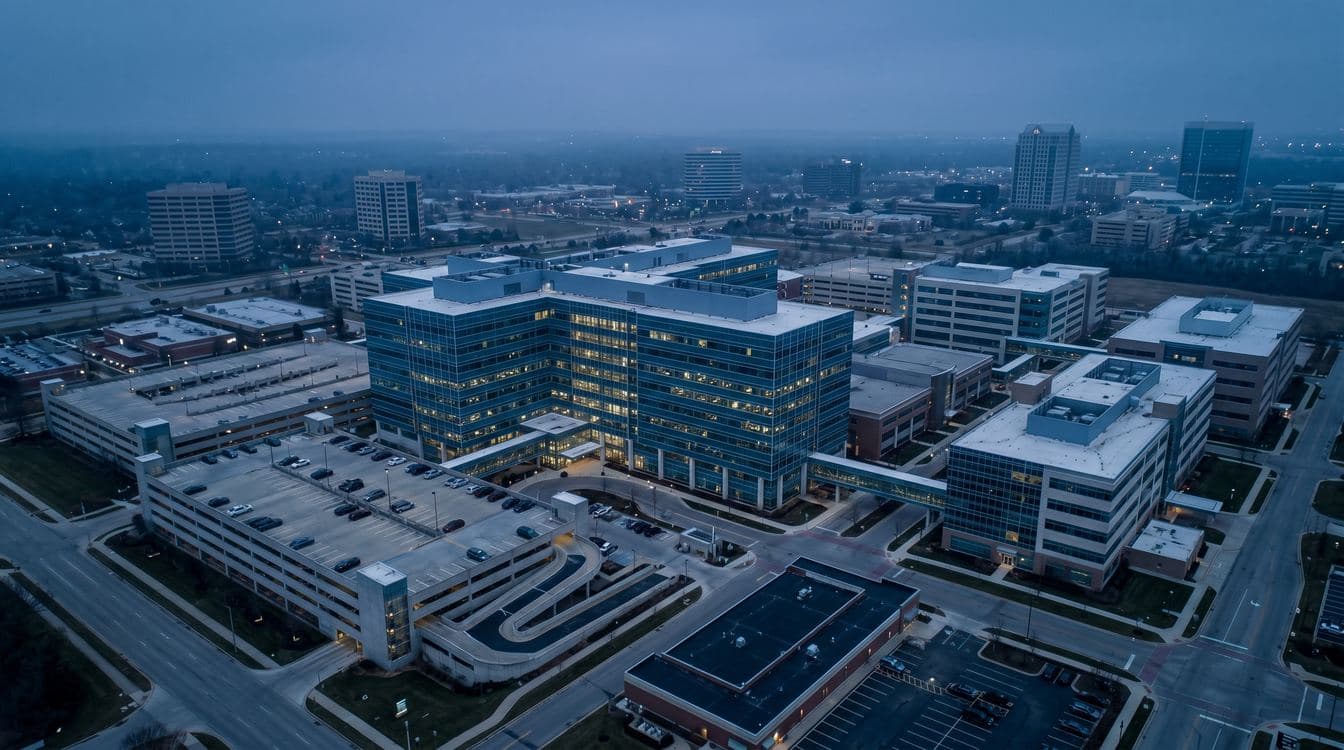
TL;DR. PE took R1 RCM private at $8.9B in August 2024 and New Mountain Capital assembled a $5B payment integrity platform in eighteen months. Mid-market RCM, denial management, and prior authorization firms doing $40M-$80M in revenue are the next roll-up wave. The binding constraint is not AI capability, it is product discipline. Firms that publish hard-dollar metrics (denial rate delta, days-in-AR delta, first-pass clean-claim rate) sell into the platform at 16x EBITDA. Firms that cannot get bought at 4x revenue or not at all.
A hospital spends roughly twenty-five cents of every dollar it collects on the administrative work of collecting it. Andreessen Horowitz published that number when it led AKASA's Series B in 2021, and three years of administrative inflation later it is still defensible. That is the line item that built the careers of the PE firms now writing the biggest checks in healthcare services. R1 RCM went private in August 2024 at an $8.9B enterprise value, a 29 percent premium, bought by TowerBrook Capital Partners and Clayton, Dubilier & Rice. In the eighteen months that followed, New Mountain Capital folded Rawlings, Apixio's payment integrity unit, Varis, and Machinify into a single platform worth approximately $5B, then made a growth investment in Access Healthcare valued at roughly $2B. Bain's 2025 Global Healthcare Private Equity report counted five healthcare deals north of $5B in 2024 alone, up from two in 2023 and one in 2022.
If you run a $40M-$80M RCM, denial-management, or prior-auth firm, the next eighteen months will look different from the last eighteen. The capital is coming for your category. The question is whether you sell into it, build around it, or get rolled over.
The Roll-Up Is Already Underway
The Private Equity Stakeholder Project counted 199 RCM companies under current or recent PE ownership as of July 2024, with 104 active PE-backed platforms at that point. Mid-market deals under $500M represented more than 80 percent of 2024 sector deal count, and EV/revenue multiples ran an average of 6.1x from 2021 through 2024, up from 4.4x in the three years before. The best-in-class number is the Ensemble Health Partners deal: Berkshire Partners and Warburg Pincus invested at an enterprise value north of $5B, implying approximately 16.7x EBITDA on roughly $300M of EBITDA.
The named acquirers a mid-market healthcare admin firm should know in 2026:
- New Mountain Capital, on a tear with the Rawlings-Apixio-Varis-Machinify combine, the Access Healthcare growth investment, and an active platform search.
- CorroHealth, which carved Xtend out of Navient in September 2024 with 925 employees moving in a single transaction.
- TowerBrook plus CD&R, sitting on R1 RCM as the public-market take-private template.
- Welsh, Carson, Anderson & Stowe via EnableComp, Argos Health, and a broader RCM portfolio.
- Bain Capital and Parthenon Capital via Zelis, with Mubadala, Norwest, and HarbourVest now on the cap table of the payer-side payments platform.
Waystar's June 2024 IPO raised $968M against $791M in 2023 revenue and 42 percent EBITDA margins, putting a public-market consolidator on the field with a fresh M&A budget. Aspirion, Kovo, Meduit, Med-Matrix, and FinThrive sit one tier down with active add-on appetites.
There is no shortage of capital. There is no shortage of platforms looking to do bolt-ons. The shortage is on the supply side: the number of mid-market RCM, denial-management, and prior-auth firms with clean books, defensible client retention, and a credible AI roadmap.
What Sam Actually Sees in His P&L
This is the part the LinkedIn analysts skip. A $60M RCM firm running 700 hospital clients or 4,000 physician practices does not have the luxury of theorizing about generative AI. The operating reality looks like this.
The initial claim denial rate across U.S. hospitals climbed to 11.8 percent in 2024, up from 10.2 percent a few cycles earlier, per Kodiak Solutions and MDaudit. Hospitals lose approximately 4.8 percent of net revenue to denials, against an HFMA "healthy" benchmark of below 5 percent. Medicare Advantage denials rose 4.8 percent year over year in 2024 alone. Days in accounts receivable is creeping; Kodiak benchmarks it up 2.2 percent year over year and 5.4 percent year to date against the 2023 base.
The American Medical Association's 2024 Prior Authorization Physician Survey put the average physician at 39 prior auth requests per week and 13 hours of practice-team time consumed by them. Eighty-nine percent of physicians report PA contributes to burnout. Thirty-one percent report PAs are often or always denied. Eighty-two percent said it is common for patients to abandon recommended treatment because of PA friction.
On the staffing side, the American Academy of Professional Coders reports medical coder vacancy rates of 25 to 40 percent across U.S. health systems, with demand projected to outpace supply by 30+ percent through 2030. Thirty-five percent of providers cite staffing as their number one RCM issue. During staffing crises, days-in-AR routinely stretches from a healthy 28-35 days to 55-75 days.
CAQH's 2024 Index priced a manual prior authorization transaction at $3.41 versus $0.05 automated, a 98 percent unit-cost reduction with $20B in annual industry savings still on the table. McKinsey's administrative-waste framework pegs eliminable U.S. healthcare admin waste at roughly $265B per year, about 7 percent of total spend.
These are not abstract pain points. They are the numbers in Sam's monthly board pack, and they explain why eighty percent of health systems were exploring, piloting, or implementing generative AI for RCM in 2025, up from 58 percent in 2023, per the HFMA-AKASA survey. The customers are pulling. The capital is chasing the pull. The mid-market firms in the middle have to decide what to do about it.

Three Paths Through the Next Eighteen Months
There are three credible plays for a mid-market healthcare admin firm. Sam needs to pick one. Trying to do all three at once is how firms become acquisition targets at 3x revenue instead of 16x EBITDA.
Path 1: Sell into the platform
Translation: the firm has a defensible book, sticky multi-year contracts, and a credible AI-readiness story. It runs a process, hires bankers, and exits to New Mountain, CorroHealth, Aspirion, Kovo, Meduit, or a Welsh Carson portfolio platform. Numbers a $50M RCM with 25 percent EBITDA margins should expect in 2026: 5x-7x revenue or 12x-15x EBITDA depending on growth rate, client concentration, and AI roadmap maturity. Ensemble traded at 16.7x EBITDA. Sam's firm will not. But the comp set is generous enough that even an average-quality mid-market RCM exits at a multiple the seller could not have imagined in 2019.
The catch: PE diligence in 2026 includes an AI roadmap review. Buyers ask for first-pass clean-claim rates by payer, denial recovery rates by category, days-in-AR by client, and the named tools or models used to drive them. Firms with a credible answer get the multiples above. Firms with a slide that says "AI strategy in development" get re-traded.
Path 2: Build AI-native and scale into the wave
Translation: the firm believes the multiple compression on the next deal is worth the operational risk of building. It deploys agentic AI on top of its existing book to expand margin, then runs as a roll-up platform itself. Adonis hit roughly 4x revenue growth in 2025 with 130 percent net revenue retention. Candid Health hit approximately 250 percent revenue growth in 2024 by eliminating denials before they happen rather than recovering them after the fact. Adonis raised a $40M Series C from Quadrille Capital and General Catalyst in March 2026. Candid raised $52.5M six months after a $29M round. AKASA raised $120M in June 2024 to scale generative AI across the 650+ hospitals and 6,500 outpatient sites already on the platform. These are the comp set for a mid-market firm that wants to be the consolidator instead of the consolidated.
The catch: Path 2 requires Sam to write product specs his current team cannot ship. He hires a head of product, an applied ML lead, and an AI ops manager before the year is out, or he pivots back to Path 1 with a worse hand.
Path 3: Partner and white-label
Translation: the firm keeps its book and its brand and embeds AI-native tooling rather than building it. The blueprint exists. Cohere Health, Rhyme, and Medical Mutual announced an end-to-end touchless prior-auth partnership in June 2024. Humata Health is shipping inside Microsoft Dragon Copilot as of October 2025. The Access Healthcare plus SmarterDx plus Thoughtful.ai combination took the name "Smarter Technologies" in 2025. A $50M firm with a defensible client base can deploy Amperos for denial management, Candid for autonomous billing, Cohere or Rhyme or Humata for prior auth, and AKASA for end-to-end automation without building any of it from scratch.
The catch: Path 3 firms compete on operations, not technology. They get bought at 4x-5x revenue, not 6x. The strategic value of being the partner channel is real but it caps the exit multiple. Path 3 is the right answer if Sam is two years from retiring or three years from a generational handoff. It is the wrong answer if he wants the Path 1 multiple.
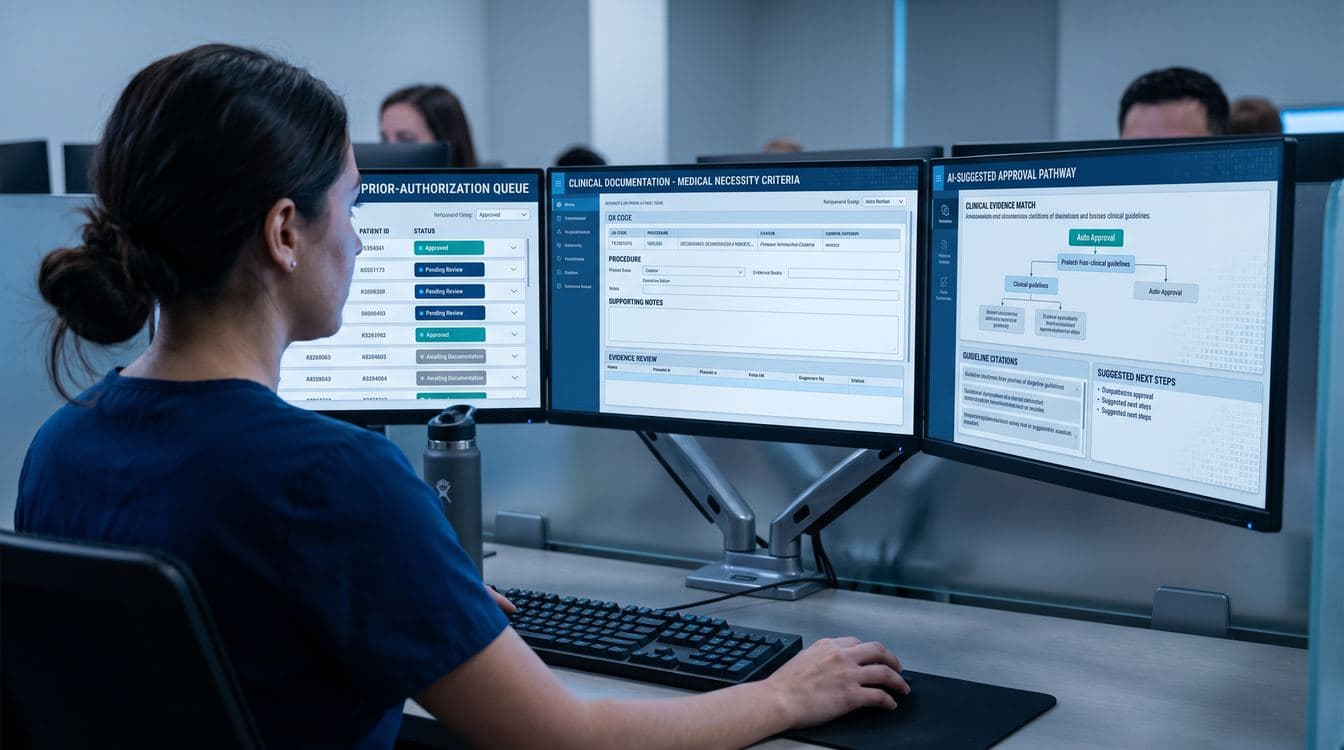
The Binding Constraint Is Product Discipline
This is where the Olive AI story stops being a joke and starts being a warning. Olive peaked at a $4B valuation in July 2021, raised $902M total across its lifetime, and shut down in October 2023. Its clearinghouse and patient access businesses were sold to Waystar. Its prior auth technology went to Humata Health, founded by Olive's former president Jeremy Friese. The collapse was not because the market did not exist. The market exists. Olive collapsed because it sold robotic process automation scripts as artificial intelligence, scaled commercial faster than product maturity, and earned a "C" from KLAS for the gap between pitch and outcome.
The binding constraint on healthcare admin AI capex in 2026 is not capital. It is not model quality. It is product discipline. A mid-market firm that can publish hard-dollar metrics on every client engagement (first-pass clean-claim rate by payer, denial recovery rate by category, days-in-AR delta, prior-auth turnaround time, coder productivity per FTE) has a path. A firm that markets "transformation" without the metric framework underneath is running 2022's playbook in a 2026 buyer's market.
This is the line Bain and KLAS drew in their October 2025 RCM AI investment report. Aaron Feinberg, the Bain partner on the work, framed it directly: executives want "quickly scalable solutions that address key business challenges and pay for themselves with tangible results and short time-to-value windows." The repetitive, rules-based nature of RCM makes it the natural proving ground for agentic AI, but the firms that win the next eighteen months are the ones whose buyer due diligence finds receipts, not vision decks.
Bessemer made the same point at the venture level in its 2024 State of Health Tech: healthcare's "$4 trillion headline TAM" is misleading because the system is "4,000 $1 billion markets" rather than one big one. RCM, denial management, prior auth, and patient access are each one of those $1B-$10B sub-markets. Each will have a winner. The winner in each will be the firm that can show its work.
What the Money Is Actually Buying
PE is not paying 16x EBITDA for the spreadsheets. It is paying for the operating-cost gap between running an RCM operation in 2024 and running it in 2027 with agentic AI on the front line. That gap is 30 to 50 percent of operating cost in a mid-market firm. Capture half of it inside an EBITDA pre-bridge to closing and the exit math becomes obvious.
The firms that close that gap in 2026 will look like this from the outside: a head of product with healthcare admin operating history, an applied ML team of three to six people, a hard-dollar metrics framework the CFO publishes monthly, builds or partnerships against three or four AI-native vendors for the highest-leverage workflows, and a CEO who can defend the AI roadmap in a diligence call without flinching. From the inside, they look like operations companies that hired enough product talent to stop being only operations companies.
If this is the conversation already happening at your firm, we should talk. Granular sits in the operational rooms where mid-market healthcare admin operators are working out which path they are on and what to build first. We design and ship the agentic-AI tooling and the metric frameworks that buyers will diligence in eighteen months. Fixed price, four weeks, working tool. Book thirty minutes with us and we will tell you what we are seeing.
Keep Reading
- Why Specialty Finance Is the AI Vertical Nobody Is Targeting: the parallel Money Flows piece on commercial lending, factoring, and equipment finance, where the same operational gap is open.
- The Case for Hiring an Internal AI Ops Lead at $50M: if you are going Path 2 from this post, this is the operating role you cannot run the play without.