Harvey vs Spellbook vs CoCounsel: $40M Law Firm Teardown
At $40M, Harvey is mostly out of reach, Spellbook is the practical default for transactional work, and CoCounsel makes sense if you live in Westlaw.

TL;DR. At $40M, Harvey is mostly out of reach. Real commits start around $250K to $288K a year with 20 to 25 seat floors, and the AmLaw build is overkill for most mid-market workloads. Spellbook is the practical default for transactional and commercial work at roughly $180 to $300 per seat per month inside Microsoft Word. CoCounsel only makes sense if your firm already lives in Westlaw, because it adds $100 to $200 per seat per month on top of a $200 to $400 Westlaw base. Most mid-market firms end up running two of the three, not one.
At a $40M law firm, the AI question is no longer whether to buy. According to Clio's 2025 Legal Trends Report, AI adoption among midsize firms jumped from 19% to 93% in twelve months. Actionstep's 2026 US Midsize Law Firm Priorities Report, based on 274 mid-market professionals, puts the use number at 95% with one critical caveat: 46% don't fully trust the safeguards in place, and only 38% have integrated AI with core practice management. Adoption is solved. Integration is not.
Harvey's enterprise sales cycle still runs about six months. Spellbook will hand you a 7-day trial today and a quote inside a week. CoCounsel arrives bundled with whatever Westlaw conversation your firm is already having. The choice is which AI fits the work your firm actually does at a price that justifies the seat. This is the honest teardown.
What "AI for a $40M law firm" actually means
A $40M firm typically runs 60 to 150 attorneys depending on practice mix. Three categories drive most AI spend:
- Contract review and drafting. Commercial agreements, MSAs, NDAs, employment, financing. Volume-heavy, playbook-driven, Microsoft Word native.
- Legal research and brief drafting. Case law lookup, KeyCite verification, memo drafting, citation checking. Live primary law required.
- Document analysis and diligence. Due diligence review, deposition prep, timeline generation, cross-jurisdictional analysis. Heavy upload, structured output.
Harvey, Spellbook, and CoCounsel each over-index on one of those. None does all three equally well, despite what the marketing pages say.
The pricing reality
| Tool | Per-seat price | Floor | Annual commit | Standalone? |
|---|---|---|---|---|
| Harvey | $1,000 to $1,200/mo base; $2,400 with LexisNexis content bundle | 20 to 25 seats | ~$288K typical; some firm-wide deals report ~$150/seat | Yes |
| Spellbook | Industry-estimated $180 to $300/mo | 10 seats | ~$24K to $36K at lean tier | Yes |
| CoCounsel | $100 to $200/mo add-on | Requires Westlaw | $1,200 to $2,400 per seat per year on top of Westlaw | No, Westlaw bundle only |
Numbers above reflect publicly reported figures and analyst estimates as of mid-2026. Per eesel AI's leaked Harvey seat tier breakdown, a 100-attorney mid-market Harvey deployment models to $1.97M to $2.25M in Year 1 once licenses, premium support, implementation, training, and fine-tuning are added up. That is not a typo. Spellbook's full-firm 40 to 50 seat deployment lands in the $7,200 to $15,000 per month range per AI Vortex's 2026 analysis. Different products solving different problems at different orders of magnitude.
Harvey at $40M: who it is for and who it is not
Harvey raised over $500M at an $11B valuation and is deployed across most of AmLaw 100 and a chunk of Fortune 500 in-house teams. The platform is purpose-built for matter-scale document workflows: M&A diligence across thousands of documents, cross-jurisdictional advisory work, litigation-grade analysis at scale. At $40M, that mostly is not your work.
Harvey's mid-sized firm landing page exists, but contracts still anchor at 20-seat minimums and 12-month commitments. Plain AI's Spring 2026 review reports annual minimums around $288,000, a six-month enterprise sales cycle, no self-serve, no monthly billing, no trial. Procurement involvement is required. The LexisNexis content bundle raises total cost by about one-third.
Harvey makes sense at a $40M firm in a narrow case: a high-billable-rate corporate or M&A practice generating consistent diligence work, 20 to 40 seats you can dedicate to that practice group, and a blended billable rate above $600 an hour. Outside that profile you are paying AmLaw rates for mid-market work.
A 25-seat Harvey deployment at $1,200 per seat per month is $360,000 a year for licenses alone. At a $40M firm, that is just under 1% of revenue going to one AI vendor for one workflow. If that workflow does not produce attorney leverage on its own, you have funded a procurement headache, not a force multiplier.
Spellbook at $40M: the practical mid-market default
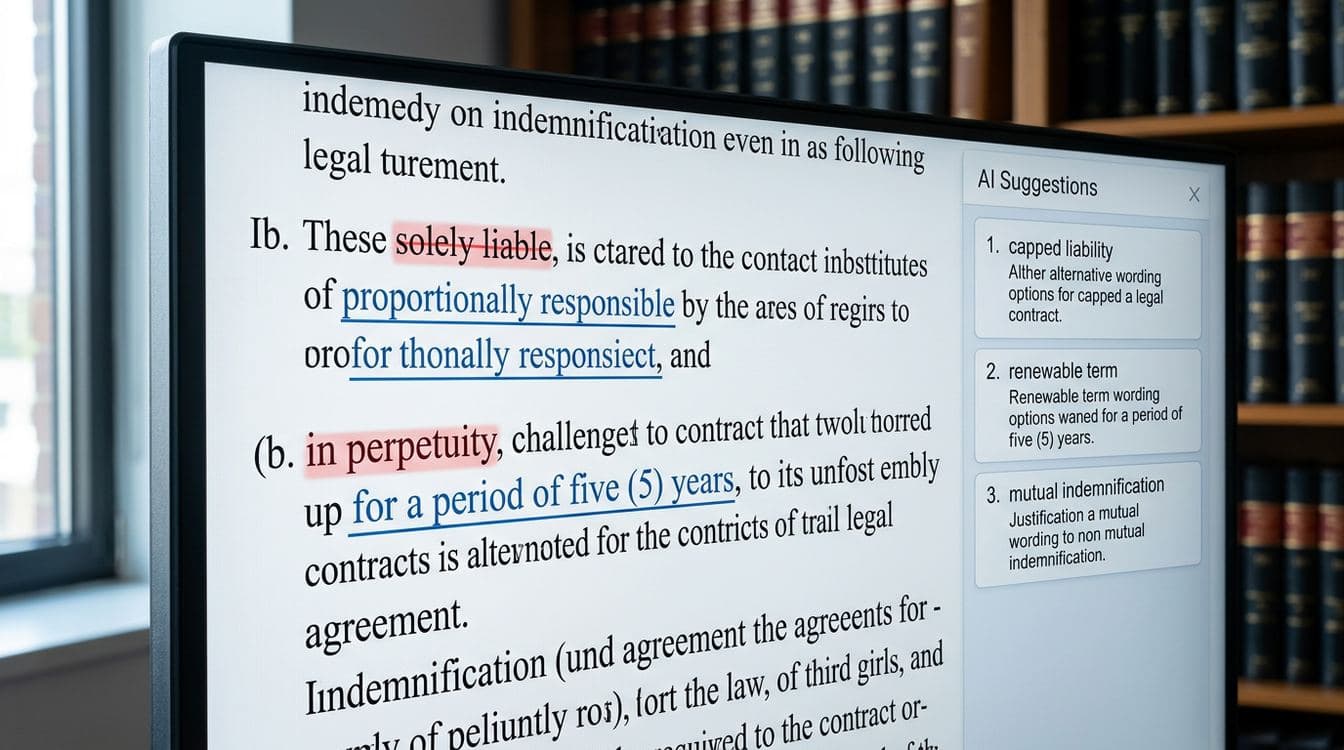
Spellbook is built where most mid-market commercial work actually happens: inside Microsoft Word. Attorneys open a contract, hit a sidebar, get redlines against the firm's playbook, suggested clause language, market benchmarking against thousands of similar agreements, and citation lookups. The Word add-in is the product.
The customer base reflects that fit. Spellbook reports more than 4,500 legal teams in 80+ countries. The company raised a $50M+ Series B in late 2025, runs 155 employees out of Toronto, and powers the product with GPT-5 and Claude Opus. A 7-day free trial is available without sales involvement, which itself signals who the product is for.
CallSphere's April 2026 analysis calls Spellbook "the contract AI most US mid-market law firms picked in 2026." That tracks with what we see at $30M to $80M firms: Spellbook is what gets deployed first, usually in the transactional practice group, usually before anyone has framed the broader AI strategy.
Where Spellbook fits cleanly:
- Commercial transactional practice with 30+ contract reviews per month
- Existing Microsoft 365 stack with attorneys already drafting in Word
- 10 to 50 seats concentrated in M&A, commercial, or employment groups
- Need for playbook enforcement against firm-standard positions
- In-house legal teams supporting mid-market companies
Where Spellbook does not fit:
- Litigation-heavy practices needing primary law research and KeyCite verification
- Firms whose contract work is already managed in a contract lifecycle management platform like Ironclad or DocuSign CLM
- Practices needing matter-scale diligence across 10,000+ document repositories
Negotiation note: 2026 is the most aggressive window of Spellbook's commercial lifecycle. Series B funding-allocation room means pricing concessions are available, especially on multi-year terms. Push on data portability, training-data export, and exit clauses. Get the per-seat rate below $200 if you can commit to 20+ seats.
CoCounsel at $40M: when Westlaw makes the call
CoCounsel is Thomson Reuters' AI platform layered over Westlaw and Practical Law, built from the 2023 Casetext acquisition. The product is grounded in primary law: every cited case carries a live KeyCite signal, every research output pipes through the verified Westlaw corpus, and the new CoCounsel Legal flagship (launched August 2025, with a next-generation release announced June 22, 2026 for August general availability) adds workspaces, a Brief Builder AI agent, and organizational intelligence built on Anthropic models.
The catch is the bundle. CoCounsel is not sold standalone. You buy it as an add-on to Westlaw, and that math drives the decision. Per AI Vortex's 2026 CoCounsel pricing analysis, the typical total cost lands at $300 to $600+ per user per month once you stack Westlaw subscription, CoCounsel add-on, and tier modifiers. GC AI's June 2026 comparison puts the configurator-based price for solo attorneys on Westlaw Advantage with CoCounsel Essentials at $639.20 per user per month on a 1-year term, $519.35 on a 3-year term. Larger firms negotiate down from there.
CoCounsel makes sense if three conditions all apply:
- Your firm is already on Westlaw and the renewal is up in the next 18 months.
- Your work is at least 50% case-law research and litigation-grade drafting.
- You want the AI layer to inherit Westlaw's authority and KeyCite signals rather than verifying citations against a separate research database.
If you are not on Westlaw, the math collapses fast. A litigation-light $40M commercial firm paying $400 per seat per month for Westlaw plus $150 for CoCounsel is funding $6,600 per attorney per year for research authority on work that doesn't require deep research. That's fragmented AI spending.
If you are already running Westlaw firm-wide, negotiate CoCounsel inclusion during your next Westlaw renewal rather than as a separate purchase. Thomson Reuters has historically held the line on standalone availability because the bundle is the strategy.

The Lexis+ AI question
Lexis+ AI is the LexisNexis equivalent to CoCounsel and the same bundle logic applies: if your firm is already on Lexis content, Lexis+ AI is the path of least resistance. If you are not, the math collapses. At $40M, the decision is rarely Lexis+ AI vs CoCounsel as a primary AI tool. It is one of them as a research overlay on whichever content provider you already pay.
How to decide: the 4-question filter
Strip the marketing and answer four questions in order.
1. What percentage of your billable work is commercial contracts vs litigation and research?
If 60%+ is commercial transactional, start with Spellbook. If 60%+ is litigation and research, start with CoCounsel or Lexis+ AI inside your existing research bundle. If the split is even, you will probably run two tools.
2. Are you already on Westlaw or Lexis firm-wide?
If yes, the AI layer should ride that bundle. A competing research-grounded AI platform is duplicate spend.
3. Is your transactional volume concentrated in a few attorneys, a practice group, or firm-wide?
A few attorneys: Spellbook's lean deployment (10 to 15 seats) at $1,990 to $4,500 per month. Practice-group concentrated: 20 to 30 seats at $3,600 to $9,000. Firm-wide: 40 to 50 seats at $7,200 to $15,000. Match the spend to actual seat utilization, not headcount.
4. Do you have a corporate or M&A practice generating 100+ diligence matters per year with blended billable rates above $600?
If yes, Harvey enters the conversation. If no, Harvey is the wrong tool and the cost will not pencil regardless of how good the demo looks.
Most $40M firms end up running Spellbook in transactional work and CoCounsel or Lexis+ AI as a research overlay on existing content. The all-Harvey scenario is rare below $100M. The no-AI scenario does not exist anymore.
FAQ
Should a $40M firm consider Harvey at all?
Only if you have a corporate or M&A practice with 20+ attorneys generating consistent matter-scale diligence work, billable rates above $600, and budget for a $288K+ annual commit. Outside that profile, Harvey will overshoot the work and underperform on ROI.
Can a $40M firm negotiate Spellbook below $200 per seat per month?
In 2026, yes, particularly on a 2-year or 3-year commit with practice-group volume. Industry estimates put the rate floor near $180 per seat per month for mid-market commercial deployments. Push for free model upgrades during the contract term and a 30-day termination notice with full data export.
If we are already paying Westlaw, is CoCounsel worth the add-on?
If your litigation and research workload is heavy and your team already runs research through Westlaw daily, the $100 to $200 per seat per month CoCounsel add-on usually pencils on attorney time saved. The new Brief Builder agent (releasing generally in August 2026) materially shifts the workflow toward drafting, not just research. Negotiate inclusion during your next Westlaw renewal rather than as a separate purchase.
What about ChatGPT Enterprise or Claude for Business as the alternative?
A $60 to $200 per seat per month enterprise AI subscription handles 60% to 70% of the work Harvey and Spellbook do. You lose legal-specific guardrails, playbook enforcement, KeyCite verification, and citation grounding. For mid-market commercial work, the gap matters. For research-grounded litigation, it matters more.
What this means for your firm
A $40M firm has roughly 18 months to move from "AI is in 95% of the firm" to "AI is integrated across systems, people, and workflows." The vendor decision is part of that. The harder part is connecting whichever tool you pick to your document management system, practice management platform, time and billing stack, and knowledge management infrastructure.
The Actionstep data says 83% of mid-market firms use three or more tools per matter and only 38% have integrated AI with core systems. The gap is not the AI. The gap is the operational architecture around it.
If you are weighing Harvey vs Spellbook vs CoCounsel and the bigger question is how the choice fits into your firm's broader operations, we have had this conversation with mid-market law firm operations leaders enough times to have an opinion. Book 30 minutes with us and we will walk through your stack and the workflow you are actually trying to fix. No demo, no deck.
Keep Reading
- Practice Management Software for $40M Law Firms. The companion teardown on Clio, MyCase, PracticePanther, and the practice management layer that sits underneath any AI tooling.
- Why PE Can't Buy Your Law Firm (But Owns Everything Else). The Money Flows piece on PE capital flowing into legal services around partnership ownership rules, and what that means for AI infrastructure spend.