How $40M Manufacturers Cut Scrap From 6% to 2%
Most $40M manufacturers run real scrap at 2-3x what their monthly reports show. Here is the workflow change that closes the gap and pulls scrap under 2%.
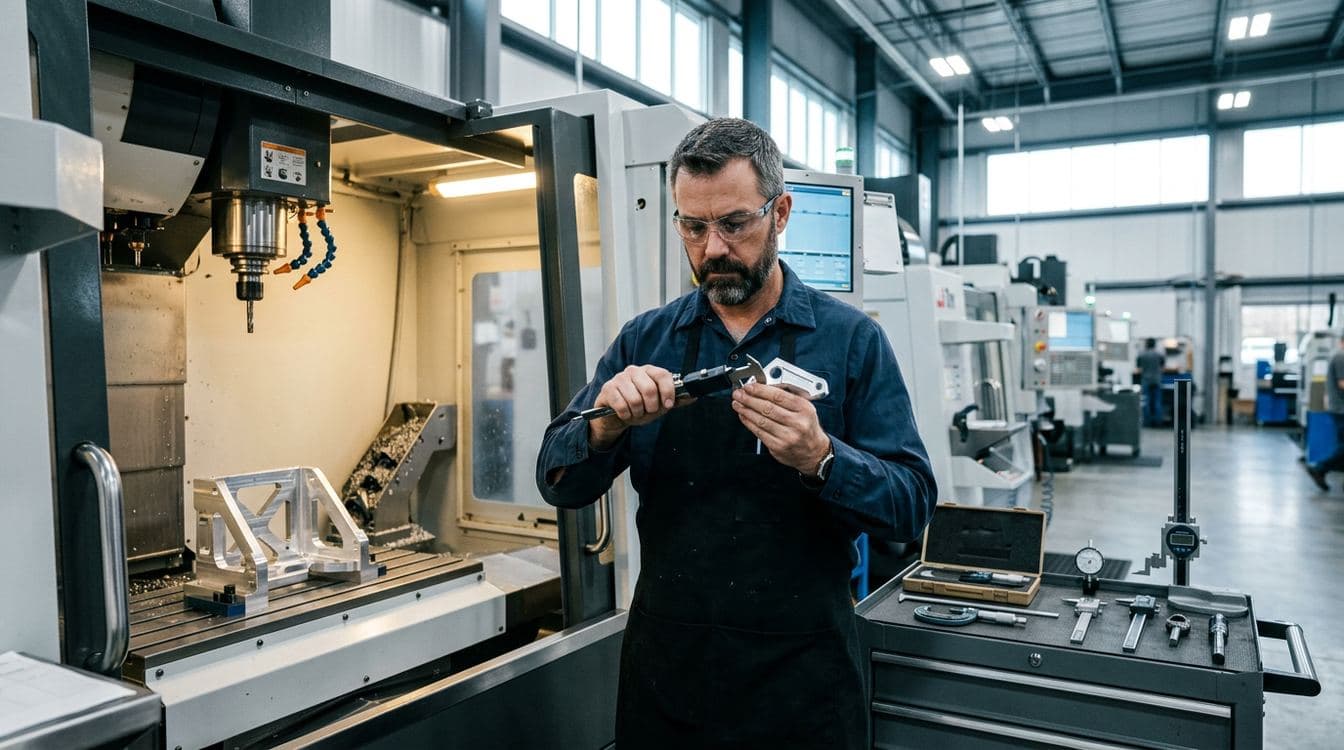
TL;DR. Most $40M discrete manufacturers report scrap at 1-3% and actually run 4-8% when you measure it at the machine instead of the end of shift. Closing that gap is the single highest-leverage operational change a mid-market plant can make. The workflow that drives scrap from 6% to under 2% has five parts: real-time capture at the point of production, mandatory first-article inspection before run quantities release, statistical process control on the dimensions that drift, scrap costed at fully-burdened rates back to the job, and a 15-minute scrap review with the floor every morning.
You probably run scrap at 6%, not 3%. Your monthly report says 3%. The real number lives somewhere your ERP cannot see, because scrap reporting in a mid-market discrete shop runs on paper, end-of-shift tallies, and the discipline of operators under production pressure. Connect a few machines, run honest counts for a week, and you will find 20-25% more scrap than your report shows. The structural fix is to capture every non-conforming event at the point of production, route it to job cost in real time, and run a five-minute root-cause loop on each one within 24 hours. The plants that do this consistently get to 1-2% scrap. The plants that do not stay at 4-8% indefinitely.
The gap between reported and real scrap
The Fabricators and Manufacturers Association 2023 Financial Ratios and Operational Benchmarking Survey put average scrap and rework at 1.4% of sales across 28 metal fabrication shops in fiscal year 2022, with top-quartile shops under 1.0%. That is the cleanest authoritative benchmark for the sheet metal and stamping sub-audience. Plastics injection molders typically run 2-10% with under 1% as the target (PlastikCity scrap survey). High-mix CNC job shops sit between 2-3% as a "budget" rate with shops that have uncontrolled setup variation pushing 7% or higher.
The catch: those are the reported numbers, from shops that have already invested in tracking. Most $40M manufacturers haven't. The practitioner consensus is that a plant reporting 1% scrap on paper is almost always running 2-4% in reality, and one published analysis from Symestic noted that the first week of connecting machines to digital capture at one plant surfaced 22% more scrap than the operator paper reports, "and nobody was lying. The data channel had never existed."
The data channel is the issue. End-of-shift paper reports filter scrap through three layers of compression: the operator counts what they can remember, the foreman aggregates by job, the system records by part number. Setup scrap gets bundled with run scrap. A worn tool that produced 40 bad parts at 11am gets logged as "in-process defects, miscellaneous" at 4pm. The plant cannot see the pattern because the data was never captured at the resolution that would show it.
Why scrap costs you 3 to 5 times what your ERP shows
Most shops cost scrap at material value. That is wrong by a factor of three to five. The American Society for Quality puts total cost of poor quality at 15-20% of revenue for average manufacturers and under 5% for world-class operations, with scrap and rework alone running 0.6-2.2% of revenue. ASQ's framework counts the raw material consumed, all labor and machine time at every operation that touched the part, the overhead allocated to those operations, the disposal and handling cost, and the replacement run that consumes machine time and scheduling capacity a second time. For a capacity-constrained shop, a missed slot for a scrapped job often means overtime, late delivery, or expedite freight.
Walk the math at your own shop. A $40M manufacturer running 3% scrap by material value, with a 3x multiplier, is bleeding roughly $3.6M a year in full-cost scrap impact. The ERP shows you the $1.2M material line. The other $2.4M is buried in labor variance, capacity loss, expedite freight, and the late-shipment penalties you absorbed quietly last quarter. Cutting scrap from 6% to 2% on a $40M base is worth $1.6M in material alone; apply the 3x multiplier and you are talking $4-5M in recovered margin. That is the difference between a 4% and a 12% EBITDA shop.

Five root causes that consistently surface
Across the industry literature and operator forums (the Practical Machinist scrap rates thread is a good practitioner-voice sample), five root causes account for most of the scrap delta between a 6% shop and a 2% shop.
1. Setup scrap mixed with run scrap. The first one to three pieces after every setup are at elevated scrap risk. In high-mix shops with frequent changeovers, this is where most controllable scrap lives. If you bundle it with run scrap in your reporting, you cannot improve it because you cannot see it. A 2% shop tracks setup scrap separately and counts every first-article rejection as a distinct event.
2. Tool wear and thermal drift caught at final inspection. A worn cutter offset can shift a profile by 0.02mm, well inside tolerance early in a run. Add thermal growth and fixture variation and you are 0.05mm out by part 30. Without in-process inspection or SPC alerts, the operator finds out at final inspection that 50 parts are nonconforming. The control plan that fixes this requires sampling at intervals tied to expected drift, not at convenience.
3. Lack of in-process sampling. First-article inspection is necessary but not sufficient. If you check the first piece and then nothing until end-of-run, an out-of-tolerance condition that develops at piece 80 runs unchecked until piece 200. A 2% shop samples every 20-30 pieces on tight-tolerance work, every 100 on stable processes, and adjusts based on Cpk data over time.
4. Supplier material variability. Batch-to-batch hardness, thickness tolerance, and contamination drive a meaningful share of process scrap in stamping, screw machine work, and casting. Shops that get to 2% have incoming inspection on critical lots and reject material that statistically cannot run the process in control. Most mid-market shops accept whatever shows up and absorb the variance.
5. Paper-based or end-of-shift reporting. This is the meta-cause that hides the other four. When scrap is logged at end-of-shift on a paper traveler, the timestamp, machine, operator, and material lot all get lost. The defect reason becomes a guess at 4pm instead of a fact at 11:15am. The pattern you cannot see is the pattern you cannot fix. We have written separately about why paper travelers persist at mid-market shops and what it costs you.
The 90-day workflow change
The sequence that drives scrap from 6% to 2% takes about 90 days and looks like this. It does not require a new ERP. It does require a real-time data layer between the floor and the system you already have.
Days 1-30: instrument the data capture. Pick five to eight high-volume machines and install touchscreen kiosks or tablets at the operator station. The cost is $15K-30K per machine for hardware plus the integration into your existing ERP. MES platforms like MIE Trak Pro's Kiosk module, MachineMetrics, and the shop floor capture features in Plex and Epicor Kinetic all handle this. Operators log scrap at the event, by reason code, with the job and machine pre-populated. The first week, count honestly without judgment. The reported number will go up. That is the data channel turning on, not a problem getting worse.
Days 30-60: enforce first-article and in-process sampling. Every new setup releases through an FAI checkpoint. The operator fixtures the first part, the inspector measures the critical dimensions on the part print, the result is logged digitally. No FAI sign-off, no run quantity release. In parallel, define in-process sampling intervals by part family and start logging Cpk for the dimensions that matter. The discipline is harder than the technology. Plants without enforcement leak setup scrap because operators rush under deadline pressure.
Days 60-90: run a daily 15-minute scrap review. Every morning, the plant manager, quality lead, and floor supervisor walk through yesterday's scrap events. By job, by machine, by operator. Five-minute root-cause loop on each one. Did a tool wear out? Was the program revision wrong? Was the material lot off? The closing question is always: what would have prevented this? If the answer is "nothing," the event is inherent process scrap and gets reclassified. If the answer is "sample at piece 50 instead of piece 100," update the control plan. The compounding effect of 250 of these reviews a year is what gets you from 6% to 2%.

What your ERP actually has to do
You do not need a new ERP. Most $40M discrete manufacturers run Epicor Kinetic, JobBOSS², ECi M1, Global Shop Solutions, or Plex, and all of them support real-time scrap capture if configured correctly. The question is whether scrap data flows back to job costing in real time, not whether the ERP "supports" it.
Test this at your own shop. Find a job that closed last week. Pull the as-quoted material cost, the as-quoted labor cost, the actual material consumed, the actual labor hours, and the scrap entries posted against the job. If those five numbers reconcile cleanly, your ERP is doing its job. If the scrap number is "miscellaneous variance" on an end-of-month roll-up, you have a data layer problem, not a software problem. A practitioner thread on the Epicor community forum walks through how shops have customized the DMR (Discrepant Material Report) workflow to surface true job-level scrap cost in Kinetic. The point is not Kinetic specifically. The point is that the default configuration in every mid-market ERP records scrap quantity against a production order without surfacing the cost attribution that lets you fix the process. The fix is a workflow change, not a software change. We have written more on what mid-market manufacturers actually need from their ERP and how to build WIP visibility on top of your existing system.
The vendor-published case studies set the floor. Plex reports that Ralco Industries, a Tier 1/2 automotive supplier, cut scrap more than 60% after replacing legacy data capture with real-time MES integration, with payback under 1.5 years. Discount for vendor framing and the result is still a major margin recovery.
FAQ
How is scrap rate actually calculated? Three ways, and you should know which you are using. Material value scrap is dollars of material scrapped divided by dollars of material consumed. Piece count scrap is parts scrapped divided by parts produced. Financial scrap is total cost-of-quality dollars (including labor, machine time, and overhead) divided by revenue. The FMA survey reports the third one because it captures the full margin impact. Most ERPs default to the first. If your reports show 1.4% and you cannot tell which method, ask.
Do I need a new ERP to do this? No. The 90-day workflow change runs on top of your existing system. The investment is in the data capture layer (kiosks, tablets, an MES module or middleware), the inspection discipline, and the daily review meeting. Replacing your ERP is a 12-18 month project that may or may not solve the scrap problem. The data layer fix takes 90 days and almost always solves it.
Is scrap different from rework? Yes, and they should be tracked separately. Scrap is non-recoverable, the part is destroyed. Rework is recoverable, the part can be salvaged with additional labor. They have different root causes, different cost structures, and different prevention strategies. A shop that lumps them together cannot improve either one efficiently. ASQ's COPQ framework treats them as distinct categories for a reason.
What this means for your shop
If you are running a $40M discrete manufacturing operation and your scrap reports show a number that has been suspiciously stable for two years, that number is wrong. The real scrap rate is higher, and the gap between the two is where your margin is leaking. The 90-day workflow change is not glamorous. It is real-time data capture, mandatory first-article inspection, daily scrap reviews, and the discipline to keep doing it after the initial improvement. The plants that hold the discipline get to 2% and stay there. The plants that drift back to paper reports and end-of-shift tallies climb back to 6% within a year.
At Granular we build the data-capture layer and the workflow that sits between your existing ERP and your shop floor. Fixed price, four-week delivery, working tool. If scrap is the line item you cannot quite explain on your monthly P&L, that is the conversation worth having. Book 30 minutes with us and bring last month's scrap report.
Keep Reading
- Why Mid-Market Manufacturers Still Print Travelers: The structural reason paper travelers persist in $30-100M shops and what they cost you on scrap visibility, job costing, and engineering change control.
- Work-in-Process Visibility for $40M Manufacturers: The data-layer companion to scrap reduction. How to see WIP, scrap, and bottleneck status in real time without replacing your ERP.