Build vs. Buy AI: What No One Tells Mid-Market Leaders
Most build-vs-buy AI advice targets Fortune 500 or startups. Here is the framework for the $30M to $100M company stuck in between.

TL;DR. The average mid-market company spent $600K on AI last year, and most of that money bought shelfware. The real build-vs-buy decision is not a binary choice. It is a spectrum: off-the-shelf SaaS, configured platforms, purpose-built tools, and full custom development. Mid-market companies ($30M to $100M in revenue) need to match each workflow to the right point on that spectrum. This post gives you the framework to do that without hiring McKinsey.
You do not need to choose between a $2M custom AI platform and a $50/seat chatbot subscription. That framing is wrong, and it is costing mid-market companies real money.
According to a Baker Tilly survey reported by CFO.com, the average mid-market company invested $600,000 in AI in 2025. But here is the part nobody advertises: a significant share of those projects stalled before they delivered measurable ROI. The companies that wasted money almost always made the same mistake. They treated the build-vs-buy decision as a single, company-wide choice instead of evaluating it workflow by workflow.
We build AI tools for mid-market businesses across construction, insurance, distribution, and field services. Fixed price, four-week delivery. We see the wreckage of bad build-vs-buy decisions every month. Here is what actually works.
The Mid-Market AI Gap Is Real
Enterprise companies (think $500M and up) have internal AI teams, dedicated budgets, and the engineering talent to build from scratch. Startups and micro-businesses buy SaaS tools and make them work. Mid-market companies, the $30M to $100M businesses that form the backbone of the American economy, get squeezed.
The World Economic Forum calls this "AI's mid-market moment." The technology is finally accessible. The talent market is loosening. But the advice has not caught up. Most AI vendor evaluation frameworks still assume you have a CTO, a data engineering team, and six months to run a pilot.
You probably do not have those things. You have a COO who also handles IT, a few sharp operators who know the business cold, and a board that wants to know what you are doing about AI before the next quarterly meeting.
That is not a weakness. It is actually a strategic advantage, if you make decisions correctly.

The Four Options Nobody Explains Clearly
MIT Sloan's research breaks the AI adoption path into "buy, boost, or build." That is helpful, but it still leaves mid-market leaders guessing. Here is a more practical breakdown, ordered from least to most custom:
Option 1: Off-the-Shelf SaaS
You subscribe to a product that works out of the box. Think AI-powered CRM features, automated scheduling tools, or document processing services. The vendor handles everything. You configure, you do not code.
Best for: Workflows that look identical across industries. Email triage, meeting transcription, basic document search. If a thousand other companies have the same problem, someone has probably built the SaaS for it.
Watch out for: The "good enough" trap. A general-purpose AI tool might handle 70% of your quoting workflow, but that last 30% is where your margin lives. An HVAC contractor's quoting logic is nothing like an insurance underwriter's, even though both call it "quoting."
Option 2: Configured Platforms
You buy a platform (think low-code tools, configurable AI suites) and customize it to your business. More flexible than pure SaaS, but you are still working within someone else's architecture.
Best for: Businesses with internal operators who can manage configuration. Works well for project management, CRM workflows, and reporting dashboards where the core logic is standard but the details are yours.
Watch out for: Platform lock-in and configuration debt. We have seen $60M distribution companies spend 18 months configuring a platform, only to discover it cannot handle their specific inventory allocation logic. By then, they have sunk $200K and rewritten their processes around the tool's limitations.
Option 3: Purpose-Built Tools
Someone (an internal developer, a specialized firm, or an AI-native agency) builds a tool specifically for one of your workflows. Not a whole platform. One tool, one job, built to your specs.
Best for: The workflows that differentiate your business. The quoting process that wins you bids. The knowledge base that keeps your best estimator's expertise alive after she retires. The claims routing system that cuts processing time in half. These are the workflows where generic tools cost you money because they do not understand your business.
Watch out for: Scope creep. A purpose-built quoting tool should not become a purpose-built ERP. Define the boundaries before you start.
Option 4: Full Custom Development
You build a complete AI system from the ground up. Custom models, custom infrastructure, custom everything.
Best for: Almost nobody in the mid-market. This is a Fortune 500 play. If you are reading this and your company does under $100M, you almost certainly do not need this and cannot sustain it.
Watch out for: Vendors who pitch this because the engagement is larger. If someone is quoting you a 12-month AI transformation roadmap, they are selling you Option 4 when you need Option 3.
The Decision Framework: Workflow by Workflow
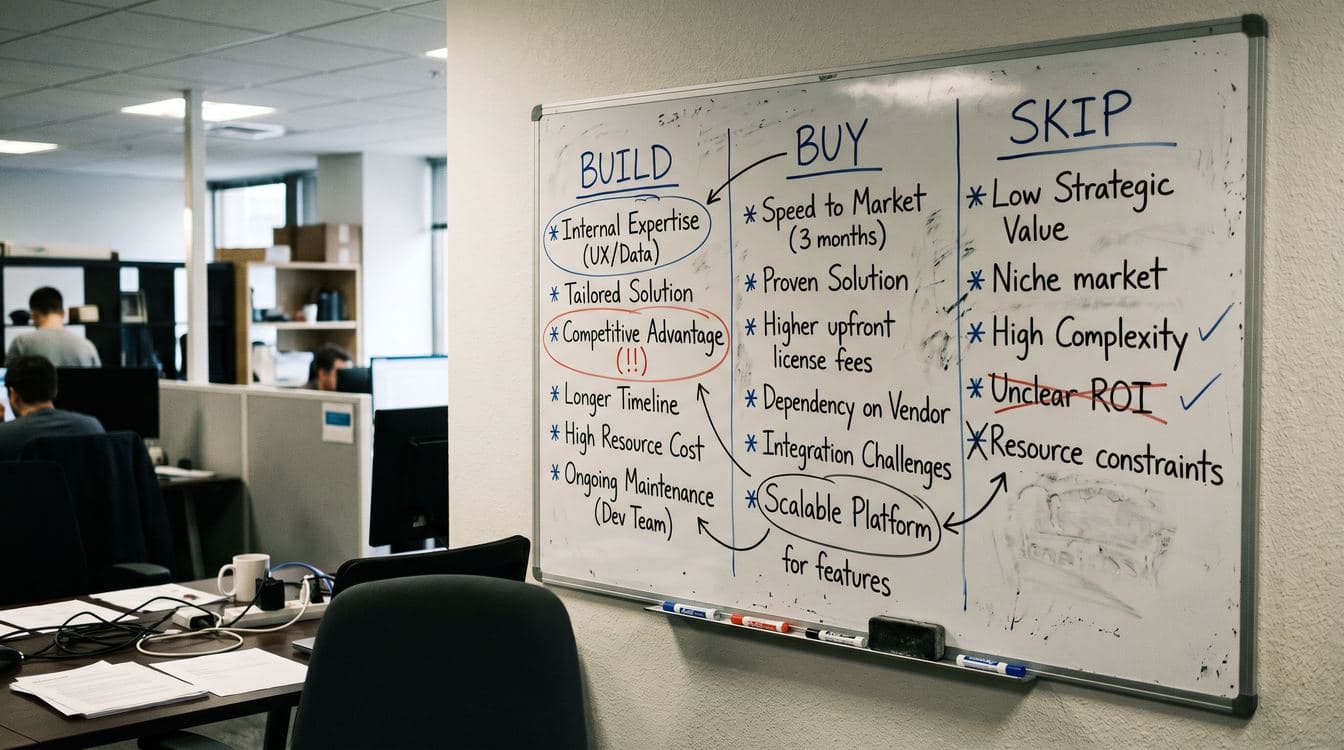
Here is the part most advice gets wrong. You do not make one build-vs-buy decision for your company. You make it for each workflow independently. A $50M general contractor might use off-the-shelf AI for meeting transcription (Option 1), a configured platform for project tracking (Option 2), and a purpose-built tool for subcontractor bid analysis (Option 3). All three are correct choices for their respective workflows.
The framework comes down to three questions:
Question 1: Is this workflow generic or specific to your business?
If every company in your industry does it the same way, buy. If your version involves proprietary logic, institutional knowledge, or competitive differentiation, build (purpose-built, not full custom).
A final expense insurance company processing claims has industry-standard steps, but their underwriting criteria, risk models, and agent workflows are specific. The standard steps can be bought. The differentiation needs to be built.
Question 2: What is the cost of "almost right"?
Some workflows tolerate a tool that is 80% accurate. Internal meeting summaries, for example. Nobody gets fired over a mediocre meeting transcript.
Other workflows demand precision. A $40M distributor misquoting inventory availability loses a customer permanently. An HVAC contractor sending the wrong crew to the wrong job site wastes $3,000 in labor before lunch. For these workflows, "almost right" is more expensive than "not automated at all."
"We tried three different off-the-shelf quoting tools before we realized the problem was not the tool. It was that nobody outside our business understands how we price change orders."
Question 3: Does someone on your team own it after delivery?
Every AI tool needs an owner. For SaaS, that person manages the subscription, trains the team, and handles vendor relationships. For purpose-built tools, that person understands the business logic well enough to say "this output looks wrong" when it does.
If nobody on your team can own it, you are not ready for that option yet. That is okay. Start with something simpler and build capability over time.
What the Vendor Will Not Volunteer
Here are the red flags we see mid-market buyers miss repeatedly.
"We can do everything." No vendor does everything well. The ones who claim to are either lying or selling you a platform you will spend 18 months configuring. Ask for three references from companies your size, in your industry, using the specific feature you need. Not logos on a slide. Phone numbers.
"ROI in 90 days." According to the Stanford HAI 2026 AI Index Report, the median enterprise reports a 2.4x ROI on AI investments, but that is an aggregate number across years and across companies with dedicated AI teams. For mid-market companies, realistic ROI timelines depend on the workflow. A well-scoped, purpose-built tool can pay for itself in weeks. A misconfigured platform can burn money for a year before anyone admits it is not working.
"You need our data platform first." This is the enterprise upsell. You do not need a data lake before you can automate a quoting workflow. You need clean input for that specific workflow. The data platform can come later (or never, depending on your business).
"AI will replace your team." No. At your scale, AI makes your existing team faster. The estimator who takes 6 hours per quote does it in 90 minutes. The claims processor who handles 15 cases a day handles 40. You are not cutting headcount. You are multiplying capacity.
How to Run the Evaluation in 30 Days
Stop running six-month vendor evaluations. Here is the compressed version:
Week 1: Pick your highest-value workflow. Not the easiest one, the one where automation delivers the most revenue or margin impact. For a $70M contractor, that is probably quoting or sub-bid analysis. For an insurance administrator, it might be claims intake and routing. For a distributor, inventory reordering.
Week 2: Map the workflow as it exists today. Every step, every decision point, every place where someone checks a spreadsheet or calls a colleague. Document the inputs and outputs. This exercise alone often reveals that the workflow is more specific than any SaaS tool can handle.
Week 3: Talk to three vendors. One SaaS, one platform, one purpose-built. Give each the same workflow map. Ask: what can you automate today, what requires customization, and what is your pricing model? If anyone cannot answer in a week, they are not built for mid-market speed.
Week 4: Compare delivery timelines, not just price. A $150K purpose-built tool delivered in four weeks will beat a $60K SaaS tool that takes six months to configure and still does not handle your edge cases.
The Bottom Line for Mid-Market Leaders
The build-vs-buy decision is not about technology. It is about knowing which of your workflows are generic and which are the ones that make your business money. Buy the generic ones. Build (purpose-built, not custom) the ones that differentiate you.
The companies getting this right are not the ones with the biggest AI budgets. They are the ones who picked one workflow, matched it to the right option, and shipped something that works in weeks instead of months.
If you are running a $30M to $100M business and trying to figure out where AI fits, start with a 30-minute discovery call. We will tell you which of your workflows are worth building for and which ones you should just buy off the shelf. No transformation roadmap. No 47-slide deck. Just a straight answer.
For more on capturing the operational knowledge that makes your business unique (before you try to automate it), read How to Capture Tribal Knowledge Before Key People Leave.